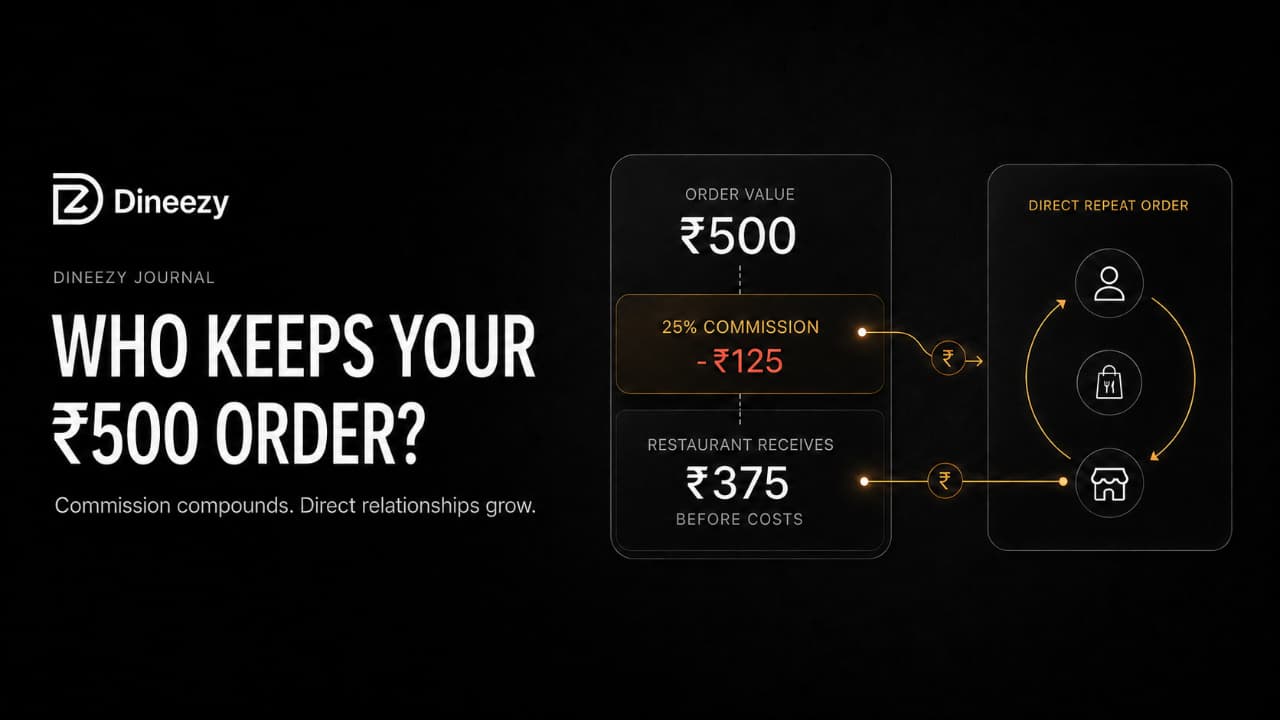
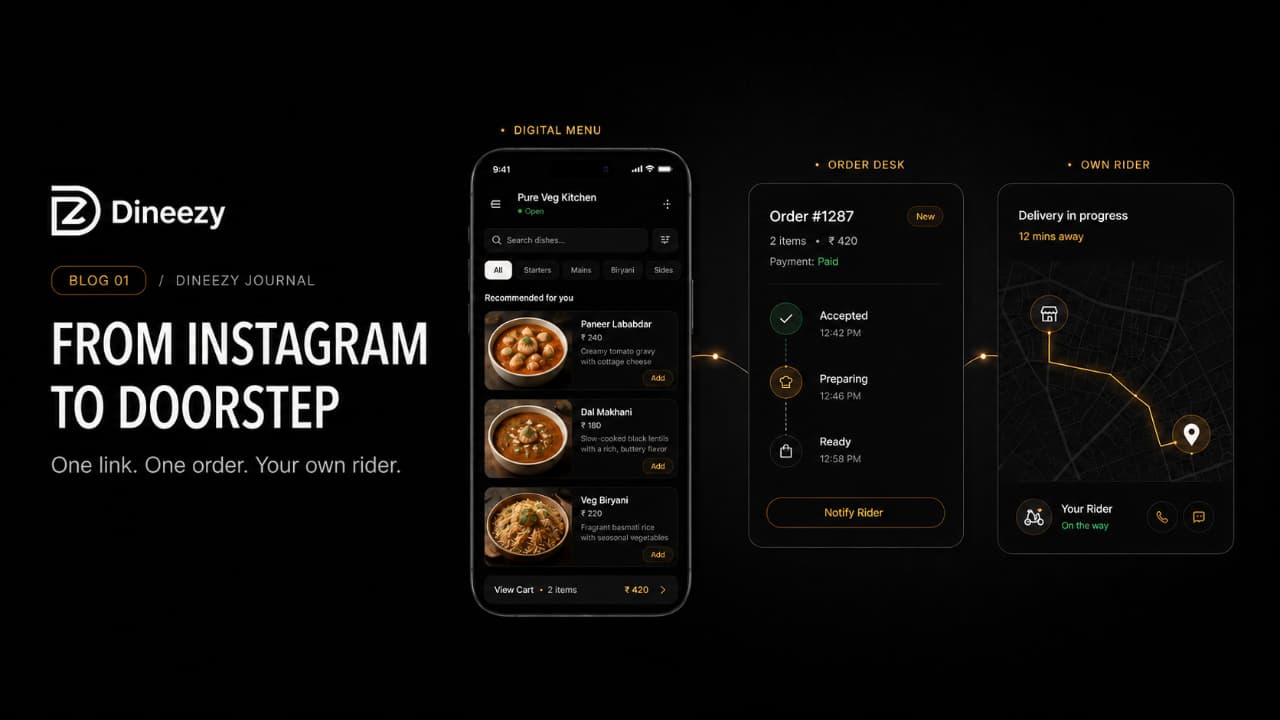
Your Restaurant Served 1,000 Customers. How Many Can You Bring Back?
Serving 1,000 customers does not create a loyal customer base. Learn how restaurants can connect customer data, loyalty, WhatsApp follow-ups and direct ordering to generate repeat visits.
Dineezy Team
2 Sept 2026 · 6 min read

On this page20 sections
- Your Restaurant Served 1,000 Customers. How Many Can You Bring Back?
- A busy restaurant is not always building loyalty
- The value of bringing back 100 customers
- Why restaurants lose contact after the first visit
- The customer remains anonymous
- The order happened through another platform
- Loyalty exists only on paper
- Every customer receives the same message
- There is no simple way to return
- What a useful customer profile should explain
- A better repeat-customer journey
- Loyalty should create a reason to return
- WhatsApp should be useful, not noisy
- Four customer-retention numbers to track
- Repeat customer rate
- Days between orders
- Reward redemption rate
- Direct repeat orders
- How Dineezy connects the journey
- Final takeaway
Your Restaurant Served 1,000 Customers. How Many Can You Bring Back?
Your restaurant served 1,000 customers this month.
The tables were busy. Orders kept coming. The billing counter recorded every sale.
But next month, how many of those customers can you bring back?
Not how many might return by chance.
How many can your restaurant identify, understand and invite back through a direct relationship?
If the answer is unclear, your restaurant may have completed 1,000 transactions without building 1,000 customer relationships.
A busy restaurant is not always building loyalty
Consider a vegetarian family restaurant in Lucknow.
During one month, it completes 1,000 customer orders with an average order value of ₹600.
Monthly sales: 1,000 × ₹600 = ₹6,00,000
The restaurant knows:
Total orders
Total sales
Popular dishes
Payment collected
But it cannot clearly answer:
Which customers were visiting for the first time?
Who returned during the month?
What did each customer previously order?
Who earned loyalty points?
Which customers have not returned?
How can they place their next order directly?
The restaurant knows the revenue.
It does not fully know the customers behind that revenue.
The value of bringing back 100 customers
Suppose 100 of those customers place another ₹600 order next month.
That creates:
100 repeat orders × ₹600 = ₹60,000
If 200 customers return:
200 repeat orders × ₹600 = ₹1,20,000
These are illustrative numbers, not guaranteed results.
The point is simple: a small improvement in repeat orders can create meaningful revenue without requiring the restaurant to find every customer from the beginning again.
But customers do not return only because the restaurant sends more discounts.
They return when the food, service, convenience and follow-up give them a reason.
Why restaurants lose contact after the first visit
The customer remains anonymous
A customer visits, eats, pays and leaves.
The restaurant records the bill but may not connect it to a useful customer profile.
The next time that person visits, the restaurant treats them like a completely new customer.
The order happened through another platform
An aggregator may bring the order, but the restaurant may have limited control over the customer relationship and next-order journey.
The customer remembers the delivery application instead of saving the restaurant’s direct ordering link.
Loyalty exists only on paper
A physical loyalty card is forgotten at home.
A printed coupon is lost.
Points are earned, but customers do not know their balance or how to use it.
Every customer receives the same message
A customer who regularly orders Paneer Lababdar receives the same promotion as someone who visits only for breakfast.
Messages become easy to ignore when they are not connected to customer behaviour.
There is no simple way to return
Even an interested customer may not reorder if they have to search for the menu, call the restaurant, repeat their address and wait for confirmation.
What a useful customer profile should explain
A restaurant does not need to collect unnecessary information.
It needs enough information to serve the customer better and support a return visit—with appropriate consent and communication preferences.
A useful customer profile may connect:
Customer name
Phone number
Visit or order history
Favourite or frequently ordered dishes
Dine-in, takeaway or delivery preference
Average order value
Loyalty points or digital credit
Coupons issued and redeemed
Last order date
Direct ordering history
The purpose is not to fill another dashboard.
It is to answer practical questions:
Who visited? What did they order? When did they last return? What relevant reason can we give them to come back?
A better repeat-customer journey
Consider Rahul, who visits the restaurant with his family.
He orders:
Paneer Lababdar
Dal Makhani
Butter Naan
Veg Biryani
Gulab Jamun
After completing the order, Rahul receives his bill and loyalty information through WhatsApp.
A few weeks later, he receives a relevant next-visit message.
He taps the restaurant’s direct ordering link, opens the digital menu and uses an eligible reward.
He can choose:
Dine-in
Takeaway
Reorder
Car dining
Home delivery
The restaurant does not need to acquire Rahul again from zero.
His first order created a path to the next one.
Loyalty should create a reason to return
A loyalty programme should be easy to understand.
The customer should know:
What they earned
Where they can see it
When they can use it
Whether it expires
How to place the next order
Restaurants can use different types of benefits:
Loyalty points
Digital credit
Next-visit coupons
Visit-based rewards
Customer-specific offers
The reward should support profitable behaviour.
A restaurant does not need to give a large discount to every customer. Sometimes, a smaller benefit with a clear deadline is enough to encourage the next visit.
WhatsApp should be useful, not noisy
WhatsApp can connect the restaurant with customers after an order, but every message should have a reason.
Useful messages may include:
Digital bills
Loyalty balance
Next-visit benefit
Order updates
Reorder link
Relevant menu launch
Reminder before a reward expires
Follow-up after a long period of inactivity
Avoid sending the same discount repeatedly to every contact.
Frequency, consent and relevance matter.
The objective is not to send more messages.
It is to make the next order easier.
Four customer-retention numbers to track
Repeat customer rate
How many customers ordered more than once during the selected period?
Days between orders
How long does a customer normally take to return?
Reward redemption rate
How many issued rewards were actually used?
Direct repeat orders
How many returning customers ordered through the restaurant’s own channel?
These numbers help the restaurant understand whether loyalty and follow-ups are creating real customer activity.
How Dineezy connects the journey
Dineezy brings customer ordering, digital bills, loyalty, direct ordering and WhatsApp follow-ups into a connected restaurant system.
The journey can look like this:
First order → Customer profile → Loyalty benefit → WhatsApp follow-up → Direct ordering link → Repeat order
Dineezy cannot guarantee that every customer will return.
Food quality, service, pricing and customer experience still matter.
The system gives the restaurant something equally important: a clear and convenient way to build the next customer interaction.
Final takeaway
Serving 1,000 customers is valuable.
Knowing how many were new, how many returned and how many can be reached again is more valuable.
A busy restaurant may complete thousands of orders while rebuilding its customer base from zero every month.
A connected retention system helps turn individual transactions into longer customer relationships.
Your restaurant does not need every customer to return.
It needs to stop losing the customers who already want to.
Dineezy Team
Author at Dineezy