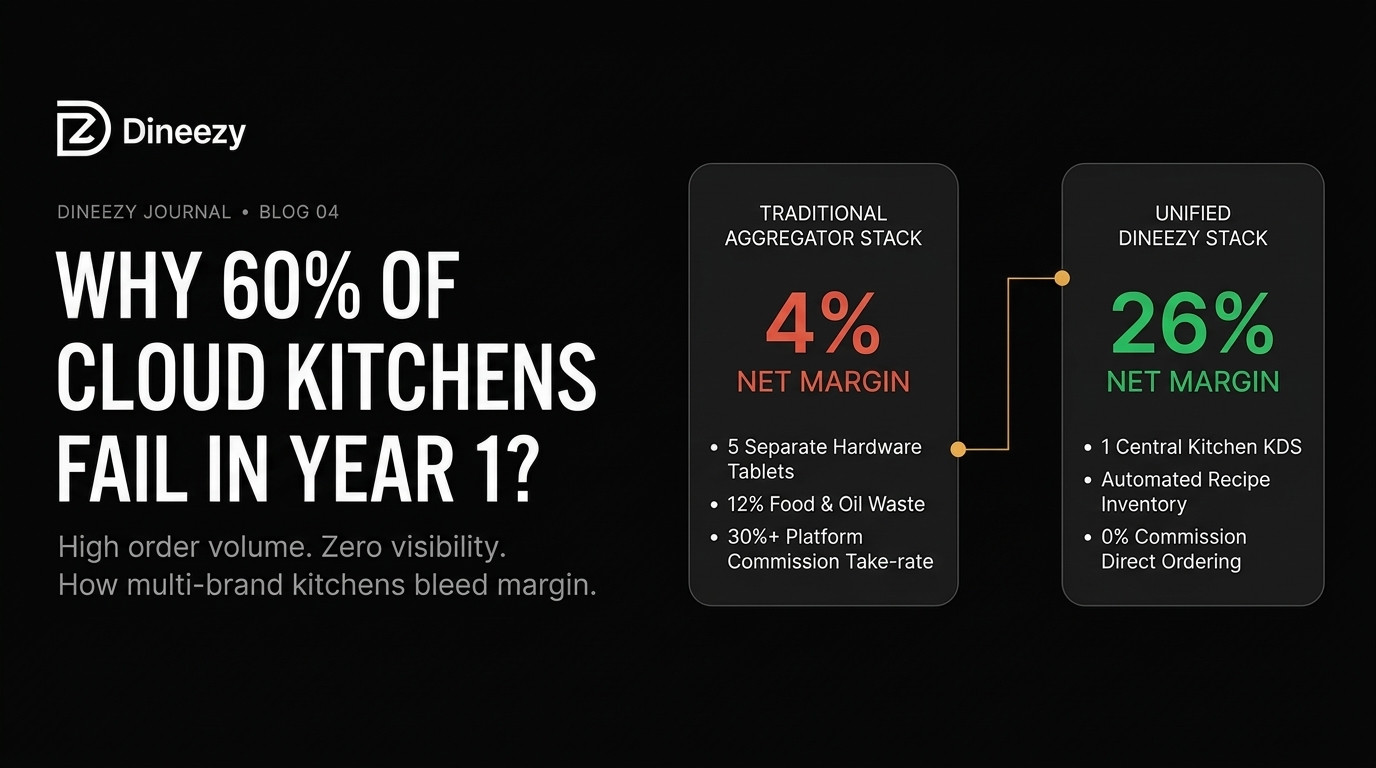
Why 60% of Cloud Kitchens Fail in Year 1 (And the Multi-Brand POS Stack That Keeps Margins Above 25%)
Introduction: The Golden Promise and Brutal Reality of Indian Cloud Kitchens On paper, the cloud kitchen business model looks like an unbeatable commercial…
Dineezy Team
8 Sept 2026 · 10 min read
On this page19 sections
- Introduction: The Golden Promise and Brutal Reality of Indian Cloud Kitchens
- Trap #1: The "Tablet Farm" Nightmare & Order Delay Penalties
- The Cascade of Operational Failure
- Trap #2: The Recipe Costing Illusion & Invisible Inventory Variance
- Trap #3: The Aggregator Commission Drain (The 30% Ceiling)
- Trap #4: Anonymous Diners & Zero Repeat Loyalty
- The Solution: The High-Margin Multi-Brand POS Stack
- 1. Unified Multi-Brand Kitchen Display System (KDS)
- 2. Automated Recipe-Level Inventory Deductions
- 3. The "Aggregator to Direct WhatsApp" Migration Funnel
- 4. Automated Customer CRM & Smart Weekend Re-Order Loops
- The Financial Transformation: Before vs. After Dineezy
- Frequently Asked Questions (FAQs)
- Q1. Can one kitchen really operate 4 or 5 different brands on Dineezy?
- Q2. How do direct delivery orders get fulfilled without Swiggy/Zomato riders?
- Q3. How long does it take to set up recipe inventory management?
- Q4. What hardware is required to run Dineezy in a cloud kitchen?
- Take Control of Your Cloud Kitchen Margins Today
- Ready to Boost Your Cloud Kitchen Margins Above 25%?
Introduction: The Golden Promise and Brutal Reality of Indian Cloud Kitchens
On paper, the cloud kitchen business model looks like an unbeatable commercial thesis. No expensive prime street frontage in Indiranagar or Connaught Place. No plush dining room interiors, air-conditioning bills, or frontline service waitstaff. Just a commercial stainless steel kitchen tucked into an industrial lane, churning out high-margin delivery orders across multiple virtual food brands on food aggregators like Swiggy and Zomato.
Between 2021 and 2026, the Indian ghost kitchen ecosystem exploded. Over 40,000 cloud kitchens opened across Tier-1 and Tier-2 Indian cities. Enticed by low upfront capital expenditure (often under ₹10–₹15 Lakhs), ambitious culinary entrepreneurs rushed in.
Yet, industry data reveals a sobering metric: more than 60% of Indian cloud kitchens shut down within their first 12 months of operation.
The tragedy is not lack of delicious food. In fact, many of these failing kitchens boast 4.3-star food ratings and consistent daily order volume. The failure is almost entirely operational and technological. Operating in the dark without physical foot traffic, cloud kitchens bleed cash through hidden aggregator take-rates, unmonitored raw material variance, chaos across multiple tablet screens, and zero customer retention.
In this guide, we break down the exact five operational traps causing cloud kitchens to collapse in Year 1, and present the modern, multi-brand restaurant technology stack that successful operators use to maintain net profit margins above 25% with Dineezy.
Trap #1: The "Tablet Farm" Nightmare & Order Delay Penalties
Step inside an average cloud kitchen during the 8:30 PM weekend rush. On the dispatch counter sits a chaotic "tablet farm":
- Tablet 1 ringing loudly with a Swiggy order for Brand A (Biryani).
- Tablet 2 flashing a Zomato order for Brand B (Burgers).
- Tablet 3 managing Magicpin or ONDC tickets.
- Tablet 4 trying to track phone-in delivery requests.
Each tablet has its own alert tone, its own proprietary merchant dashboard, and its own receipt printer. The kitchen supervisor is frantically running back and forth, manually copying orders from aggregator screens onto handwritten paper slips for the cooks.
The Cascade of Operational Failure
This manual workflow introduces three fatal defects:
- Punching Errors: A cook misreads a handwritten slip and prepares a chicken burger without cheese, or misses an urgent allergen note ("no peanuts"). The customer complains, demands a refund, and leaves a 1-star review.
- Preparation Time Spikes: Manual order entry adds 4 to 7 minutes of dead time to every ticket. Aggregator algorithms detect kitchen delays and automatically throttle the brand's visibility in search rankings.
- Rider Bottlenecks: Multiple delivery riders arrive simultaneously, crowding the kitchen doorway, grabbing the wrong paper bags, and creating delivery disputes that cost the operator thousands in compensation penalties.
The Operational Reality: A cloud kitchen cannot scale horizontally across multiple virtual brands if every new brand requires another hardware tablet and manual staff supervision.
Trap #2: The Recipe Costing Illusion & Invisible Inventory Variance
Ask a struggling cloud kitchen founder what their food cost is, and they will usually answer: "About 28% to 30%."
Ask them what their actual physical inventory variance was last Tuesday, and they have no idea.
There is a massive chasm between theoretical food cost and actual consumed inventory:
| Ingredient Metric | Theoretical (Recipe Standard) | Actual Physical Reality | Operational Variance Leak |
|---|---|---|---|
| Paneer / Tikka Cut | 180 grams per portion | 220 grams (Cook over-portioning) | +22% raw material drain |
| Refined Oil / Ghee | 35 ml per curry | 55 ml (Unmeasured ladle pour) | +57% oil consumption |
| Packaging Boxes | 1 box per meal | Damaged / wasted / unaccounted | 8% packaging shrinkage |
| End-of-Day Food Spoilage | < 2% forecast waste | 8%–12% unmanaged expiry | Direct bottom-line write-off |
In a dine-in restaurant, high beverage and liquor sales can sometimes cushion kitchen over-portioning. In a cloud kitchen, food cost and packaging are 100% of the product cost. A 6% unmonitored variance between theoretical and physical inventory erases half of a cloud kitchen's net profit.
Trap #3: The Aggregator Commission Drain (The 30% Ceiling)
Cloud kitchens depend entirely on delivery aggregators for initial customer discovery. However, relying on aggregators as your sole sales channel makes long-term profitability mathematically impossible.
Let us look at the actual P&L of a multi-brand cloud kitchen generating ₹10,00,000 (₹10 Lakhs) in monthly delivery sales strictly through third-party platforms:
⚠️ The Unit Economics of Pure Aggregator Dependence:
• Gross Monthly Food Sales: ₹10,00,000
• Platform Base Commission (23%): -₹2,30,000
• 18% GST on Commission: -₹41,400
• Co-funded Platform Discounts & Deals (~12%): -₹1,20,000
• Sponsored Ad Keyword Bids to maintain ranking (~6%): -₹60,000
• Total Aggregator Deductions: -₹4,51,400 (45.1% Total Platform Drain!)
• Net Payout to Kitchen: ₹5,48,600
• Raw Material & Food Costs (32%): -₹3,20,000
• Commercial Kitchen Rent & Utilities: -₹90,000
• Kitchen Staff & Cook Payroll: -₹1,10,000
• Net Profit Remaining to Founder: +₹28,600 (2.86% Net Margin)
The founder spent 30 days working 14-hour shifts in a sweltering commercial kitchen, managed 4 cooks, produced 2,500 food orders, and took home less than ₹30,000. One broken commercial refrigerator or one unexpected municipal licensing fee turns the entire month into a net financial loss.
Trap #4: Anonymous Diners & Zero Repeat Loyalty
When a customer orders a Biryani from your cloud kitchen on Swiggy, who owns that customer? Swiggy does.
The customer's mobile number is masked with a virtual routing switch. You cannot reach out to them. You cannot tell them about your Tuesday Biryani offer. You cannot ask why they haven't reordered in three weeks.
Every single month, the cloud kitchen operator starts at Zero Orders. They must bid again, pay ad CPCs again, and fund 50% discount coupons again to acquire the exact same diner who loved their food last Friday.
Without an owned customer list, customer acquisition cost (CAC) never amortizes—it compounds endlessly.
The Solution: The High-Margin Multi-Brand POS Stack
The top 40% of cloud kitchens that survive and expand into 10+ profitable locations do not work harder—they operate on a unified, high-margin software stack designed specifically for multi-brand delivery operations.
Here is how the modern cloud kitchen operating model works using Dineezy:
1. Unified Multi-Brand Kitchen Display System (KDS)
Instead of five separate tablets ringing chaotically, all incoming orders—whether from Swiggy, Zomato, your direct web portal, or WhatsApp—flow seamlessly into a single, high-contrast Dineezy Kitchen Display Screen (KDS).
- Orders are automatically parsed by preparation station (e.g., Grill Station, Fryer, Assembly).
- Cooking timers track exact preparation speed per dish.
- When a meal is boxed, the KDS prints a unified, branded packing slip with order numbers, brand logos, and rider handover tags.
- Zero handwritten slips. Zero punching delays. Zero missed order modifiers.
2. Automated Recipe-Level Inventory Deductions
With Dineezy's integrated recipe costing engine, every single time an order is punched (e.g., "1x Paneer Butter Masala"), the system automatically deducts the exact bill of materials from raw inventory:
- -200g Paneer
- -80ml Makhani Gravy Base
- -25g Butter / Cream
- -1x Microwave-safe Container
At the end of every shift, kitchen managers perform a 5-minute physical stock count. Dineezy instantly flags the exact variance: "2.2 kg Paneer discrepancy detected on Station 2." When staff knows ingredient consumption is audited digitally in real time, pilferage and over-portioning drop by over 80% within 14 days.
3. The "Aggregator to Direct WhatsApp" Migration Funnel
Smart cloud kitchens use food delivery aggregators for what they are best at: cheap top-of-funnel customer discovery.
Every single delivery bag that leaves the kitchen contains an attractive, high-converting package insert:
"Loved your meal? Order directly from us next time on WhatsApp & save 20% on every single order! Scan here for instant 1-click ordering."
When the diner scans the QR code, it opens your custom Dineezy WhatsApp Digital Storefront:
- No app download required.
- Browses your interactive digital menu with high-resolution food imagery.
- Selects items, enters delivery address, and completes 1-click payment via UPI (GPay, PhonePe, Paytm).
- The order hits your central kitchen KDS instantly—with 0% platform commission!
4. Automated Customer CRM & Smart Weekend Re-Order Loops
Because direct WhatsApp ordering captures 100% verified customer mobile numbers, your cloud kitchen builds a proprietary digital asset: an owned, loyal customer database.
With Dineezy's automated customer lifecycle tools, you can schedule high-converting WhatsApp broadcasts:
- Friday Evening Office Triggers: At 6:00 PM on Fridays, ping past corporate lunch buyers with a weekend party combo offer.
- Smart 21-Day Win-Backs: Automatically send a ₹100 discount coupon to diners who haven't ordered in three weeks.
- 5-Star Google Review Boosters: 30 minutes after delivery, an automated WhatsApp message asks: "How was your meal? Rate us on Google to get a free dessert on your next order!"
The Financial Transformation: Before vs. After Dineezy
Let us look at what happens when a 3-brand cloud kitchen doing ₹10,00,000 monthly sales migrates just 35% of its repeat orders to direct Dineezy ordering while eliminating raw material variance:
| Financial Metric | Fragmented Kitchen (Aggregator Only) | Optimized Kitchen (Dineezy Stack) |
|---|---|---|
| Gross Monthly Revenue | ₹10,00,000 | ₹10,50,000 (+5% direct AOV expansion) |
| Direct Channel Share (0% Commission) | 0% (All aggregator) | 35% (₹3,67,500 direct via WhatsApp) |
| Commission & Platform Ad Spend | -₹4,51,400 (45.1%) | -₹2,85,000 (Saved ₹1,66,400/month!) |
| Food & Packaging Cost (COGS) | -₹3,20,000 (32% with leakage) | -₹2,73,000 (26% with recipe tracking) |
| On-Demand Delivery Rider Dispatch | Included in platform take | -₹38,000 (Dunzo/Shadowfax flat ₹40 fee) |
| Kitchen Rent, Utilities & Payroll | -₹2,00,000 | -₹2,00,000 |
| Net Monthly Founder Profit | ₹28,600 (2.8% Margin) | ₹2,54,000 (24.2% Margin) |
By eliminating manual kitchen chaos, reducing raw material waste by 6%, and migrating repeat diners to zero-commission WhatsApp ordering, the operator's net monthly take-home jumps from ₹28,600 to ₹2,54,000—an extra ₹27 Lakhs in annual pure profit!
Frequently Asked Questions (FAQs)
Q1. Can one kitchen really operate 4 or 5 different brands on Dineezy?
Yes. Dineezy is built from the ground up for multi-brand cloud kitchens. You can configure multiple unique virtual storefronts (e.g., a Biryani brand, a Burger brand, a Dessert brand) with separate menus, pricing, and logos, all running out of one physical kitchen inventory and one unified KDS screen.
Q2. How do direct delivery orders get fulfilled without Swiggy/Zomato riders?
Dineezy integrates directly with on-demand hyperlocal delivery fleets like Shadowfax, Dunzo for Business, Porter, and Rapido. When a customer orders on WhatsApp, your kitchen accepts the order on the POS, and with one tap, an on-demand delivery rider is dispatched to your door for a flat fee of ₹35–₹50.
Q3. How long does it take to set up recipe inventory management?
Dineezy's onboarding specialists configure your raw ingredients, unit measurements, and recipe bills of materials within 48 to 72 hours. Once mapped, deductions occur automatically with every order punched.
Q4. What hardware is required to run Dineezy in a cloud kitchen?
Dineezy is cloud-based and hardware-agnostic. You can run the entire kitchen on standard Android or iOS tablets, Windows touchscreens, and standard thermal Bluetooth/USB receipt printers without purchasing expensive proprietary hardware.
Take Control of Your Cloud Kitchen Margins Today
Cloud kitchens remain one of the most exciting culinary frontiers in modern India. But high order numbers mean nothing if your bank balance is bleeding into third-party platform commissions and untracked kitchen waste.
Stop running your kitchen on fragmented tablets and handwritten slips. Build an accountable, high-margin multi-brand delivery powerhouse with Dineezy.
Ready to Boost Your Cloud Kitchen Margins Above 25%?
Discover how India's top cloud kitchens use Dineezy's unified KDS, recipe inventory variance tracking, and zero-commission direct WhatsApp ordering to maximize profits.
Schedule a Free Multi-Brand Kitchen Demo on Dineezy →Dineezy Team
Author at Dineezy