Stopping Restaurant Revenue Leakage: How Indian Restaurants Prevent Bill Manipulation, 'Void Bill' Scams & Cash Theft with Smart POS Controls
Introduction: The Silent Profit Bleed at the Cash Counter It is 11:30 PM on a Sunday night at a bustling 80-cover casual dining restaurant in Connaught Place,…
Dineezy Team
11 Sept 2026 · 10 min read
On this page21 sections
- Introduction: The Silent Profit Bleed at the Cash Counter
- The 5 Most Dangerous Revenue Leakage Scams in Indian Restaurants
- 1. The "Void Bill / Delete Order" Scam
- 2. The Cancelled KOT (Kitchen Order Ticket) Fraud
- 3. The "Kachha Bill" / Duplicate Receipt Trick
- 4. Personal UPI QR Code Swaps
- 5. Inventory Shrinkage and "Mise en Place" Waste Inflation
- The Financial Impact: How Leakage Destroys Profit Margins
- The 6 POS Security Controls That Stop Revenue Leakage
- 1. Cryptographic Role-Based Access Control (RBAC)
- 2. Immutable Anti-Void & KOT Cancellation Audit Logs
- 3. Zero-Interference UPI Payment Gateway Auto-Reconciliation
- 4. Digital Kitchen Display Systems (KDS) Replacing Paper KOTs
- 5. Theoretical vs. Actual Recipe-Level Inventory Deductions
- 6. Live Remote Mobile Monitoring for Owners
- Step-by-Step Implementation Checklist: Securing Your Restaurant in 7 Days
- Frequently Asked Questions
- What should we do if a customer genuinely rejects a prepared dish due to quality issues?
- Can staff still steal cash if our POS is completely digital?
- Does installing security controls slow down table turnover during peak hours?
- The Bottom Line
Introduction: The Silent Profit Bleed at the Cash Counter
It is 11:30 PM on a Sunday night at a bustling 80-cover casual dining restaurant in Connaught Place, Koramangala, or Jubilee Hills. The dining room has emptied after a grueling weekend rush, the kitchen burners are turned off, and the manager is printing the Day-End Summary (Z-Report) at the POS counter.
On paper, gross sales show ₹1,48,000. But inside the cash drawer, physical cash falls ₹3,800 short. Even more concerning, the POS report lists 14 "Void Bills" and 9 "Cancelled KOTs" totaling ₹11,200—all authorized under the manager's override PIN during the peak 8:30 PM to 10:00 PM rush.
When questioned, the staff offers familiar explanations: "Sir, the customer changed their mind after the order was punched," or "Sir, the tandoor was burning the roti so we had to cancel the item."
In reality, your restaurant just fell victim to one of the most common, systemic operational frauds in the Indian food and beverage industry: internal revenue leakage.
According to National Restaurant Association of India (NRAI) industry surveys, internal pilferage, bill manipulation, and unrecorded cash transactions siphon away between 5% and 10% of gross top-line revenue in traditional Indian restaurants and cafes. For an outlet generating ₹15 Lakhs in monthly turnover, that represents a direct loss of ₹75,000 to ₹1,50,000 in pure bottom-line profit every single month.
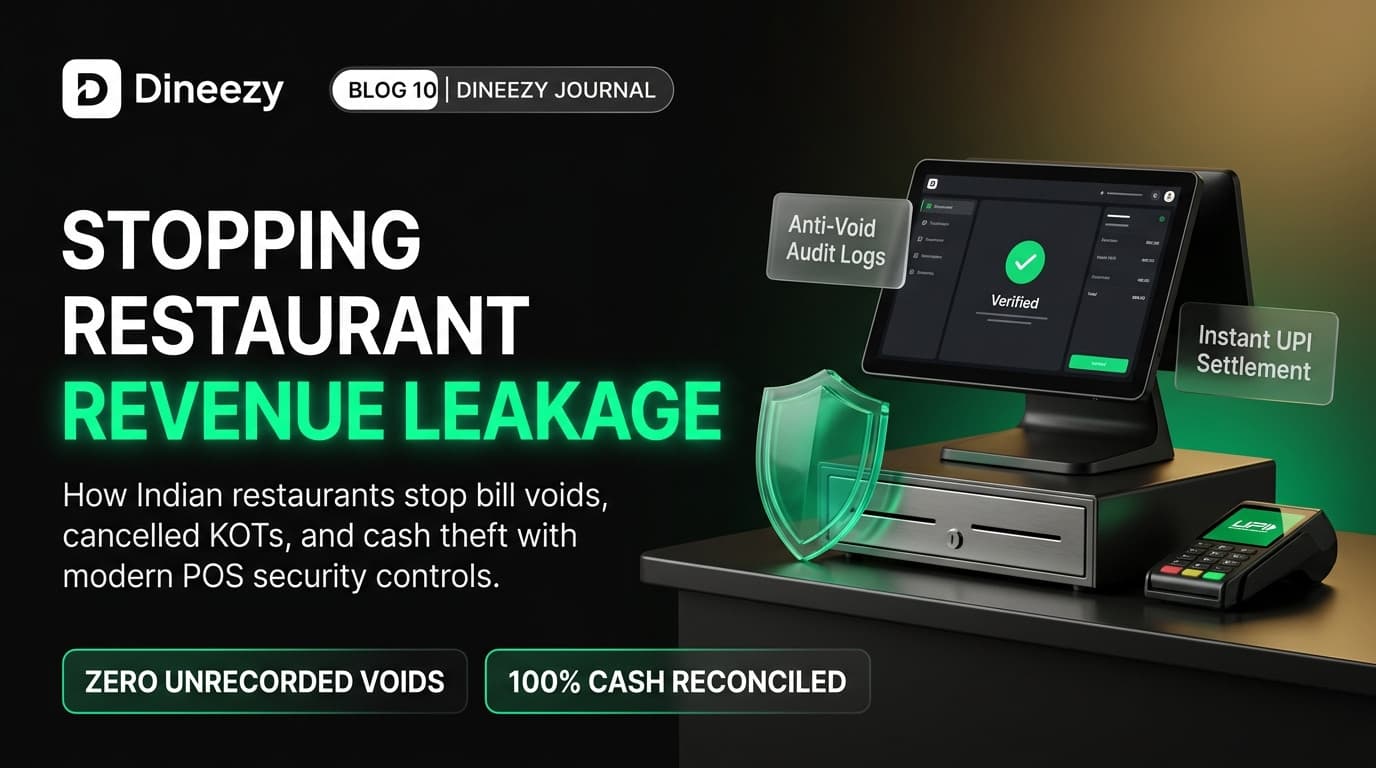
In 2026, forward-thinking restaurant owners, franchise operators, and cloud kitchen founders are putting an end to this bleed. By deploying modern cloud POS architectures equipped with role-based permission tiers, digital KOT reconciliation, immutable anti-void audit trails, and instant UPI auto-reconciliation, restaurants are closing security loopholes and securing 100% of their hard-earned cash flow.
Here is the comprehensive operational guide to identifying, preventing, and eliminating restaurant revenue theft in India.
---The 5 Most Dangerous Revenue Leakage Scams in Indian Restaurants
To eliminate revenue leakage, restaurant owners must first understand the exact operational mechanics used by rogue staff to manipulate manual or legacy billing setups:
1. The "Void Bill / Delete Order" Scam
This is the single most prevalent fraud in cash-heavy dining establishments. A table orders dinner totaling ₹2,400. The waiter delivers the food, and at the end of the meal, presents a printed "Proforma Invoice" or "Estimate Bill" to the diners.
The guests pay in physical cash (₹2,500) and leave. The cashier or floor manager immediately logs into the POS, voids the entire order or deletes the high-value food items (marking them as "Customer Refused" or "Spilled"), and pockets the cash. Because the kitchen staff already served the order and the customer received a printed estimate slip, nobody on the floor raises an alarm—while the owner never sees the sale on the books.
2. The Cancelled KOT (Kitchen Order Ticket) Fraud
In busy bars, breweries, and high-volume cafes, servers frequently punch a KOT to fire appetizers or drinks to the kitchen and bar. Once the guest consumes the food, the server asks the kitchen captain to delete or cancel the KOT ticket, claiming the guest never received it.
The server then collects the full bill amount in cash from the guest, rings up a modified bill for only water bottles or breads on the POS, and pockets the difference.
3. The "Kachha Bill" / Duplicate Receipt Trick
In legacy desktop billing software, cashiers often print an un-finalized draft receipt or a duplicate copy of a previous table's bill with an identical total. The customer pays cash believing it is an official tax invoice. The transaction is never closed in the fiscal memory of the POS, meaning zero GST is accounted for, and 100% of the cash vanishes into employee pockets.
4. Personal UPI QR Code Swaps
With 70%+ of Indian diners paying via UPI, dishonest cashiers or valet staff keep their personal PhonePe, Google Pay, or Paytm QR codes handy on their phone screens or stick duplicate UPI stickers over the official counter stand. Unsuspecting diners scan the personal QR code, the payment credits to the staff member's personal bank account, and the staff member voids the bill on the POS claiming the diner walked out without paying.
5. Inventory Shrinkage and "Mise en Place" Waste Inflation
When high-value raw ingredients—such as imported cheese, paneer, mutton cuts, butter, and liquor bottles—mysteriously disappear, kitchen managers frequently hide the theft under inflated "cooking wastage" or "burnt portions" logs. Without automated real-time inventory deduction linked to billed recipes, owners have no way of distinguishing legitimate kitchen yield from theft.
---The Financial Impact: How Leakage Destroys Profit Margins
Consider the stark economic reality of an Indian restaurant operating on standard 12% to 15% net profit margins:
| Financial Metric | Vulnerable Legacy POS (8% Leakage) | Hardened Dineezy Cloud POS (0% Leakage) | Net Monthly Margin Recovery |
|---|---|---|---|
| Monthly Gross Revenue | ₹15,00,000 | ₹15,00,000 | — |
| Unrecorded Voids & Cash Siphoning | -₹1,20,000 (8% lost) | ₹0 (Full anti-void lock) | +₹1,20,000 reclaimed |
| Food Cost / Ingredient Theft | 38% (due to hidden waste) | 31% (strict recipe deduction) | +₹1,05,000 saved |
| Effective Operating Profit | ₹75,000 (5.0% margin) | ₹3,00,000 (20.0% margin) | +₹2,25,000 / month |
| Annual Impact | Severe cash crunch | Thriving expansion capital | +₹27 Lakhs annually |
Stopping internal revenue leakage does not require hiring more floor managers or installing intrusive body scanners. It requires closing the procedural software loopholes that make theft easy and invisible.
---The 6 POS Security Controls That Stop Revenue Leakage
Here are the six mandatory operational safeguards implemented by modern enterprise POS systems to protect restaurant cash flow:
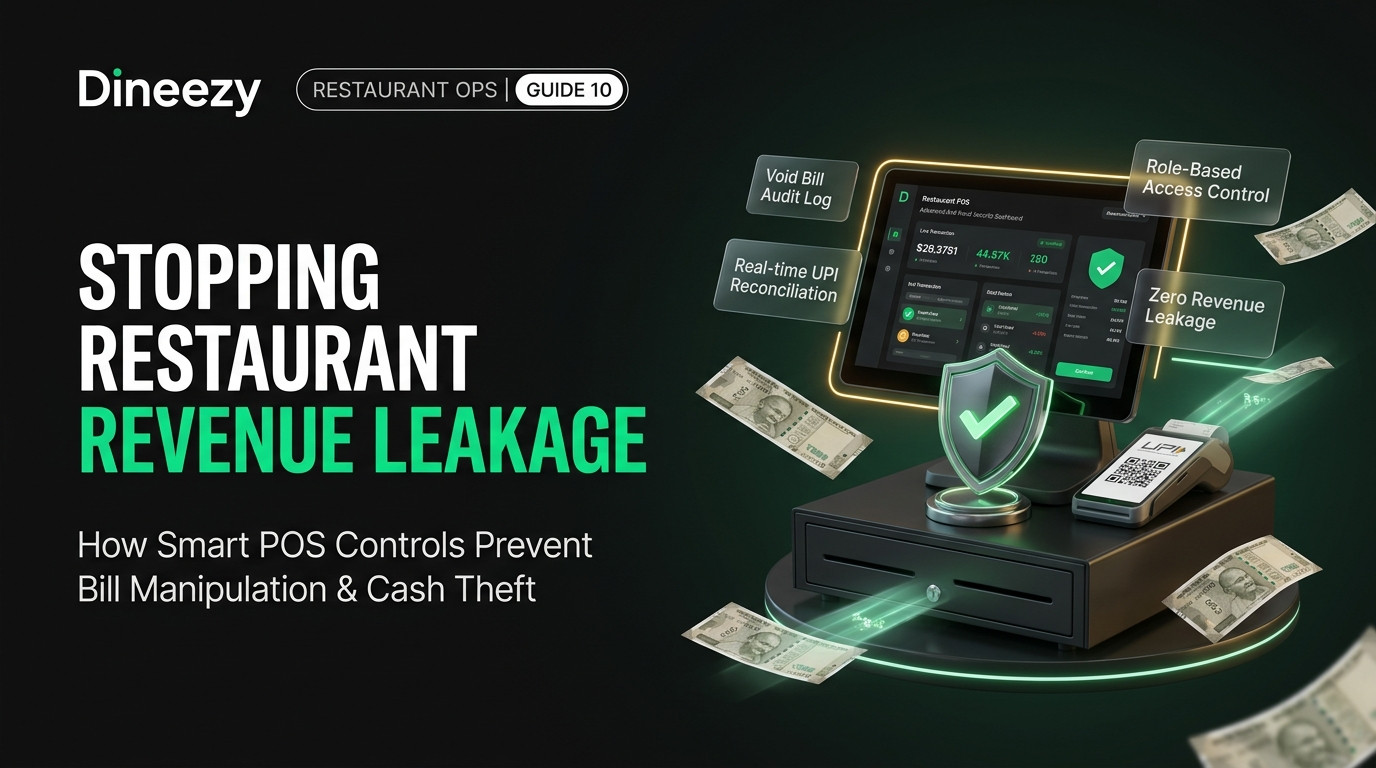
1. Cryptographic Role-Based Access Control (RBAC)
Never give floor staff or cashiers administrative billing privileges. Modern POS platforms enforce granular role separation:
- Waiters & Captains: Can only punch orders, select modifiers, and request check printing. Zero permission to void items, edit prices, or apply discounts.
- Cashiers: Can only settle open bills against verified payment modes (Cash, Card, UPI). Cannot delete closed transactions.
- Store Managers: Can approve legitimate order cancellations only by submitting a mandatory photographic reason code that instantly notifies the owner's smartphone.
2. Immutable Anti-Void & KOT Cancellation Audit Logs
Every single bill edit, discount, complimentary order (NC), and cancelled KOT creates an indelible timestamped audit log tied to the employee's unique biometric login or numeric PIN.
If a manager attempts to void a bill after food preparation has begun, the POS requires mandatory two-factor authorization and sends a live instant push notification to the owner's mobile app: "Warning: Bill #2084 (₹1,850) voided at Table 6 by Manager Sunil."
3. Zero-Interference UPI Payment Gateway Auto-Reconciliation
Eliminate personal QR code swaps and manual payment confirmation errors by deploying dynamic POS-integrated UPI QR codes. When a bill is finalized, the customer-facing screen or paper check displays a unique dynamic UPI QR code containing the exact bill amount and invoice reference ID.
The moment the diner scans and pays via GPay, PhonePe, or Paytm, the bank gateway confirms the receipt automatically via secure webhook in sub-200ms, triggering the cash drawer to lock and printing the final tax receipt without any human cashier verification required.
4. Digital Kitchen Display Systems (KDS) Replacing Paper KOTs
Paper KOTs are easily torn up and discarded by colluding kitchen and service staff. Replacing paper printers with wall-mounted Kitchen Display Systems (KDS) creates an unbreakable digital chain of custody:
- The moment an order is punched, it appears on the kitchen station screen with an active countdown timer.
- Items cannot be removed from the KDS screen without an explicit cancellation reason approved by the head chef and POS terminal.
- Every delivered plate is digitally reconciled against billed tables at end-of-day.
5. Theoretical vs. Actual Recipe-Level Inventory Deductions
Modern restaurant software connects your POS billing directly to your raw material recipes (BOM - Bill of Materials). When a customer orders a Butter Chicken, the system automatically decrements 220g chicken, 40g butter, 30g cream, and 120g tomato gravy from raw storage in real time.
At the end of the week, the system compares theoretical consumption against physical stock audits. If actual inventory usage exceeds theoretical billing by more than 2.5%, the owner receives an automated Inventory Variance Alert pinpointing potential pilferage.
6. Live Remote Mobile Monitoring for Owners
Restaurant owners cannot be glued to the billing counter 14 hours a day. Modern cloud POS systems give founders a live smartphone executive dashboard showing real-time sales, live table occupancy, discount frequencies, and cancellation spikes—whether the owner is at home, traveling, or managing multiple branch locations.
---Step-by-Step Implementation Checklist: Securing Your Restaurant in 7 Days
- [ ] Audit Existing Void Permissions: Immediately revoke universal admin passwords. Assign distinct, private 4-digit PINs to every server and manager.
- [ ] Disable "Estimate Slip" Printing: Ensure only final, numbered GST tax invoices can be printed for guests, eliminating duplicate kachha slips.
- [ ] Enable Dynamic UPI QR Billing: Switch from static counter QR stickers to dynamic, POS-generated payment QR codes with automated bank settlement.
- [ ] Configure Instant Void Alerts: Turn on instant mobile WhatsApp or push notifications for any bill cancellation exceeding ₹500.
- [ ] Transition to Digital KDS: Replace paper kitchen ticket printers with digital display monitors to establish an unbreakable order trail.
- [ ] Conduct Weekly Surprise Stock Audits: Run weekly spot checks on high-cost liquor, meat, and dairy items against POS theoretical usage reports.
Frequently Asked Questions
What should we do if a customer genuinely rejects a prepared dish due to quality issues?
Legitimate dish returns do happen. A secure POS handles this through a structured "Return to Kitchen" protocol: the manager inputs the return reason (e.g. "Undercooked / Foreign Object") along with a required kitchen supervisor confirmation. The item is logged as an accountable kitchen waste expense rather than a silent bill deletion, preserving complete inventory transparency.
Can staff still steal cash if our POS is completely digital?
If cash transactions are accepted, physical cash must always be reconciled against the system's "Cash In Drawer" ledger. Dineezy features a Blind Cash Count closure: at end-of-shift, the cashier must count and enter physical cash without seeing what the system expects. The system then automatically flags discrepancies to the owner, preventing cashiers from adjusting numbers to match the drawer.
Does installing security controls slow down table turnover during peak hours?
No. In fact, modern integrated POS systems speed up table turns by 25% to 40%. With table-side mobile captain ordering and instant dynamic UPI QR payments, guests settle bills in under twenty seconds without waiting for cashiers to manually swipe cards or fetch paper change.
---The Bottom Line
In the ultra-competitive Indian restaurant industry, running a profitable business is hard enough without losing 5% to 10% of your revenue to internal theft and administrative blind spots.
Securing your cash flow does not require confrontation; it requires modern, accountable software infrastructure.
By enforcing role-based permissions, automated UPI reconciliation, and immutable digital audit logs, you protect your bottom line, ensure fair accountability across your team, and build a resilient, multi-outlet hospitality brand.
---Ready to lock down your restaurant cash flow and eliminate revenue leakage?
Book a Free Dineezy POS Demo & Secure Your Restaurant Operations Today
Published by the Dineezy Editorial Team | Dineezy F&B Intelligence
Dineezy Team
Author at Dineezy