Table-Side QR Ordering vs. Traditional Waiters: Why the Best Indian Restaurants Use a Hybrid Model in 2026
Introduction: The 9:15 PM Saturday Night Restaurant Nightmare It is 9:15 PM on a Saturday evening in a bustling 60-seat restaurant in Indiranagar, Connaught…
Dineezy Team
9 Sept 2026 · 11 min read
On this page19 sections
- Introduction: The 9:15 PM Saturday Night Restaurant Nightmare
- The Traditional Waiter Bottleneck: Where Minutes and Margins Bleed
- The 3 Costly Defects of 100% Manual Waiter Service
- The 100% Self-Serve QR Failure: Why Guests Hated Early QR Menus
- The Solution: The 2026 Hybrid Dining Model
- The Revenue Economics: Why Hybrid Dining Unlocks +18% AOV & Massive Table Turnover
- How Dineezy Powers the Perfect Hybrid Dining Experience
- 1. Zero App Downloads, Zero Login Friction
- 2. Dynamic Menus with Real-Time Kitchen Stock Sync
- 3. Visual Food Presentation & Smart Upsells
- 4. Direct-to-Kitchen KOT Routing
- 5. Instant UPI Table Settlement & WhatsApp Billing
- Frequently Asked Questions (FAQs)
- Q1. Will older or non-tech-savvy diners feel alienated by hybrid QR ordering?
- Q2. What happens if a diner has poor cellular data reception inside the restaurant?
- Q3. Does table-side ordering mean I can lay off my waitstaff?
- Q4. Can guests order and pay directly without a waiter's intervention?
- Transform Your Dining Room with Dineezy Today
- Ready to Boost Your Restaurant Table Turnover by 20%?
Introduction: The 9:15 PM Saturday Night Restaurant Nightmare
It is 9:15 PM on a Saturday evening in a bustling 60-seat restaurant in Indiranagar, Connaught Place, or Jubilee Hills. Every table is occupied. A line of twelve walk-in diners is crowded around the host stand, waiting for a free table.
Meanwhile, across the dining room, three different tables have finished their meals and are desperately waving their hands in the air, trying to catch the eye of a frantically busy waiter.
- Table 4 wants to order one more portion of Garlic Naan and another craft beer. The waiter is occupied punching a large order at the central billing terminal. By the time the waiter arrives 8 minutes later, the guests say, "Never mind, we are done, just bring the bill." That is ₹480 in high-margin impulse sales vanished into thin air.
- Table 9 asked for the bill 10 minutes ago. The waiter finally brings the printed paper folder. The guest hands over a credit card. The waiter disappears to find the EDC card swipe machine. Five minutes later, the machine's cellular connection drops. The guest is irritated, and the table has sat empty of food for twenty-five minutes.
- At the front door, the waiting guests check their watches and walk away to the cafe next door.
This is the silent revenue hemorrhage of the traditional Indian dining room. It is not caused by bad cooking or lazy staff. It is caused by an outdated operational bottleneck: forcing every single micro-interaction—viewing menus, placing reorders, requesting bills, and settling payments—through a limited number of human servers.
In response, some restaurants tried replacing human waitstaff entirely with rigid self-serve QR codes. But that introduced its own disaster: cold, transactional dining rooms where guests felt like they were ordering from a factory vending machine.
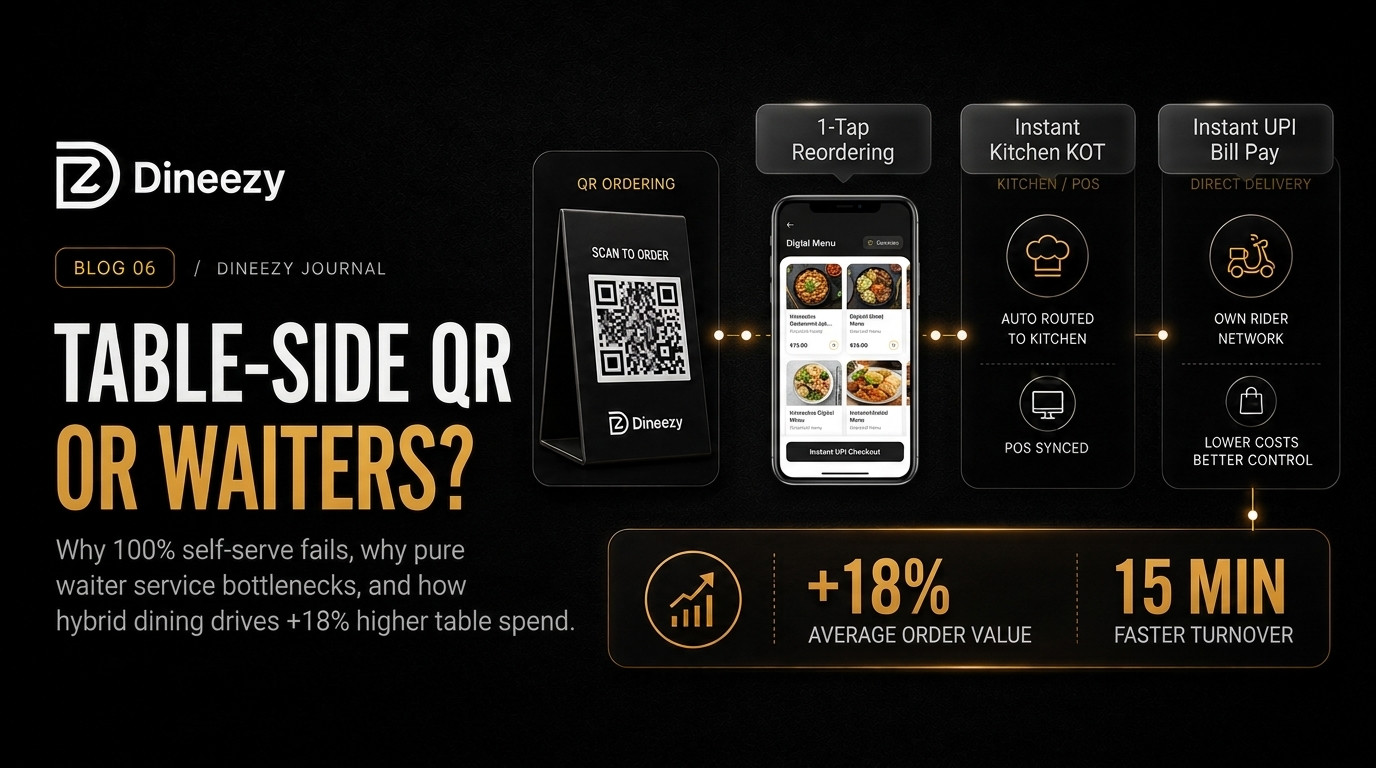
In 2026, the most profitable and highly rated restaurants in India are choosing a third path: The Hybrid Dining Model. In this comprehensive guide, we examine why both extremes fail, break down the revenue math of table turnover, and demonstrate how hybrid table-side technology powered by Dineezy drives +18% higher average order value while delivering warmer, faster hospitality.
The Traditional Waiter Bottleneck: Where Minutes and Margins Bleed
For decades, full-service dining in India has followed a rigid five-step ritual:
- Wait for a waiter to bring physical paper menus (3 to 5 minutes).
- Wait for the waiter to return, write down the order on a paper pad, and walk to the POS terminal to punch the KOT (5 to 8 minutes).
- Dine and enjoy the meal (35 to 45 minutes).
- Wave frantically to request the physical bill folder (5 to 10 minutes).
- Wait for the waiter to collect the bill, bring the card machine or QR stand, and confirm payment settlement (5 to 10 minutes).
Notice something startling: in an 80-minute dining session, nearly 20 to 25 minutes are spent waiting for service mechanics rather than enjoying food.
The 3 Costly Defects of 100% Manual Waiter Service
When dining rooms rely entirely on human servers during peak weekend rushes, three critical revenue leaks occur:
1. Missed Impulse Reorders (The Lost Beverage & Dessert Trap)
The highest margin items in any restaurant are beverages, cocktails, mocktails, appetizers, and desserts (often carrying 70% to 85% gross margins). However, these items are highly time-sensitive impulse purchases. If a diner's glass is empty, they want a refill right now. If ordering requires waving down a busy server who takes seven minutes to arrive, the impulse passes. The customer drinks free tap water instead, costing the restaurant hundreds in high-margin revenue per table.
2. Kitchen Punching Errors & Food Wastage
In the heat of dinner rush, waiters write down orders using abbreviated shorthand on paper pads. A cook misreads "No Onion / Jain" or mistakes "Butter Chicken" for "Kadai Chicken". The wrong dish arrives at the table. The diner sends it back. The restaurant must write off the dish as kitchen waste, apologize, prepare a rush replacement, and often discount the bill—erasing the entire table's profit margin.
3. The 18-Minute Settlement Jam
During a busy Friday or Saturday night, the biggest delay is never the kitchen cooking the food; it is the bill settlement loop. Printing the bill, carrying the folder, verifying split bills, fetching the card machine, or holding up a static UPI QR stand ties up servers and locks tables long after the food is finished. Every minute a finished party sits waiting for their bill is a minute that waiting walk-in customers are turned away at the door.
The 100% Self-Serve QR Failure: Why Guests Hated Early QR Menus
Following the pandemic, many restaurants attempted to solve waiter shortages by slapping generic QR code stickers on tables and telling diners: "Scan this, download our app, enter your OTP, and order everything yourself."
The backlash from Indian diners was swift and severe. Customers hated it, and for good reason:
- The PDF Nightmare: Scanning a QR code opened a clunky, non-responsive 25MB PDF menu that required endless pinching, zooming, and scrolling on a mobile screen.
- App Download & OTP Walls: Forcing guests to install a mobile app or submit to SMS verification just to see what kind of soup the kitchen served felt aggressive and invasive.
- Zero Hospitality: Dining out in India is an emotional social experience. Guests want recommendations: "Which biryani is spicier?" or "What cocktail pairs best with the prawns?" A cold, static digital screen stripped away the warmth and personal connection of hospitality.
- Exclusion of Older Diners: Multigenerational family tables felt uncomfortable navigating complex mobile checkout flows when grandparents simply wanted to order dinner.
The lesson of the last three years is clear: Technology should eliminate friction, not replace human hospitality.
The Solution: The 2026 Hybrid Dining Model
The winning paradigm adopted by leading cafes, casual dining chains, and upscale restaurants across Mumbai, Bengaluru, Delhi NCR, and Hyderabad is **Hybrid Dining**.
In the Hybrid Model, human waitstaff and table-side technology divide responsibilities based on what each does best:
| Service Stage | What the Human Waiter Does | What Table-Side Technology (Dineezy) Does |
|---|---|---|
| Arrival & Seating | Warm welcome, water service, introduces chef specials, and explains signature dishes. | Table QR tent provides immediate instant digital menu access with high-resolution food imagery. |
| Primary Order | Answers guest questions, guides wine/cocktail pairing, and takes main course orders if preferred. | Guests browse visual menu on their own phones, seeing exact allergen badges and preparation times. |
| Mid-Meal Reorders | Focuses on table clearing, water top-ups, and active guest hospitality. | 1-Tap Instant Reordering: Guests tap their phone for another drink, bread basket, or extra dip—routed directly to bar and kitchen KOT in seconds! |
| Bill Settlement | Freed from running card machines and paper bill folders; thanks guests personally. | 1-Click UPI Settlement: Guests view live running bill on phone, split bills easily, pay via GPay/PhonePe, and receive WhatsApp receipt instantly. |
| Post-Dining Retention | Invites guests back for upcoming weekend events. | Automated WhatsApp loyalty enrollment, Google 5-star review request, and birthday perks. |
By removing the repetitive, low-value administrative tasks (writing slips, typing KOTs, running payment machines), your waitstaff has double the time to provide attentive, personalized hospitality.
The Revenue Economics: Why Hybrid Dining Unlocks +18% AOV & Massive Table Turnover
Let us look at the actual financial impact of implementing the Hybrid Dining model in a 20-table casual dining restaurant generating ₹18,00,000 in monthly dine-in turnover:
📈 Financial Transformation: Traditional vs. Dineezy Hybrid Dining
1. Average Order Value (AOV) Expansion: +18.2%
• When guests have instant visual access to appetizing high-resolution food photos on their phone, appetizer and beverage attach rates jump dramatically.
• The frictionless "1-Tap Reorder" feature captures spontaneous beverage and dessert orders that guests normally skip when waiting for a server.
• Average spend per guest increases from ₹620 to ₹730.
2. Table Turnover Velocity: 15 Minutes Shaved Per Table
• By eliminating the 15-minute delay between finishing dessert, waving down the server, reviewing the paper bill, and swiping cards, tables are cleared and sanitized 15 minutes faster.
• During a 7:30 PM to 11:00 PM weekend peak, each table turns 2.8 times instead of 2.1 times.
• That translates to 14 extra seated parties per weekend evening—generating an additional ₹45,000+ in pure weekend revenue.
3. Labor Optimization & Reduced Staff Stress
• Instead of needing 8 floor servers sprinting frantically across the dining room, 5 attentive, well-trained servers manage the entire floor with zero stress, lower attrition, and higher customer satisfaction.
| Monthly Performance Metric | 100% Traditional Waiter Floor | Dineezy Hybrid Dining Floor | Net Monthly Advantage |
|---|---|---|---|
| Average Order Value (AOV) | ₹1,450 per table | ₹1,710 per table (+18%) | +₹260 extra spend per bill |
| Peak Table Turn Time | 78 minutes average | 63 minutes average (-15 min) | +22% higher seating capacity |
| Kitchen KOT Punching Errors | 3.8% of total orders | < 0.2% (Direct diner input) | Saved ₹28,000 in wasted food |
| Bill Settlement Delay | 12 to 18 minutes | Instant (< 30 seconds via UPI) | Zero table checkout bottleneck |
| Estimated Monthly Revenue | ₹18,00,000 | ₹21,85,000 | +₹3,85,000 Extra Gross Revenue! |
How Dineezy Powers the Perfect Hybrid Dining Experience
Dineezy was engineered specifically for modern Indian restaurants seeking the speed of digital automation without sacrificing hospitality warmth.
1. Zero App Downloads, Zero Login Friction
When guests sit down, they simply tap or scan the sleek, branded acrylic QR stand on their table with their smartphone camera. In less than two seconds, your interactive digital menu opens directly in their mobile browser. No app to install, no OTP to verify, and no forced logins.
2. Dynamic Menus with Real-Time Kitchen Stock Sync
If the kitchen runs out of Tandoori Pomfret or a specific craft beer tap is dry, the manager toggles it off on the Dineezy POS with one tap. The item vanishes from the digital menu instantly. No awkward moments where a waiter has to return to the table five minutes after taking an order to announce that the dish is unavailable.
3. Visual Food Presentation & Smart Upsells
Physical paper menus rely on brief text descriptions. Dineezy showcases your culinary creations with high-resolution food photography, chef tags (e.g., "Bestseller", "Chef's Signature"), and automated pairing prompts: "Add Garlic Naan for ₹60" or "Pair with Masala Lemonade for ₹120".
4. Direct-to-Kitchen KOT Routing
When guests submit an order or tap for an extra round of drinks, the ticket is instantly printed on the kitchen or bar thermal printer and displayed on the Dineezy Kitchen Display System (KDS), labeled with the exact table number. Waiters never have to run back and forth to punch tickets.
5. Instant UPI Table Settlement & WhatsApp Billing
When guests are ready to leave, they simply tap "Pay Bill" on their phone. Dineezy displays the live itemized bill, allows guests to select split-payment options, and opens their preferred UPI payment app (Google Pay, PhonePe, Paytm, or CRED) with a single tap.
Payment confirmation reflects on the cashier's screen in real time, and an eco-friendly, branded digital receipt is delivered straight to the diner's WhatsApp—capturing 100% verified customer contact data for future automated marketing campaigns.
Frequently Asked Questions (FAQs)
Q1. Will older or non-tech-savvy diners feel alienated by hybrid QR ordering?
Not at all. The beauty of the hybrid model is that physical paper menus and traditional waiter service remain available at all times. If an older family guest prefers ordering verbally with the waiter, the waiter takes the order normally on their handheld Dineezy POS. The QR code is an empowering option for diners who want speed and convenience, never an enforced barrier.
Q2. What happens if a diner has poor cellular data reception inside the restaurant?
Dineezy’s digital menus are ultra-lightweight, compressing images to load under 2G or 3G conditions in less than 1.5 seconds. Additionally, many forward-thinking restaurants offer free guest Wi-Fi where the login landing page directly opens the table’s Dineezy digital menu.
Q3. Does table-side ordering mean I can lay off my waitstaff?
We do not recommend using hybrid technology to eliminate waitstaff. Instead, use it to make your existing team twice as effective. Rather than running back and forth to punch orders and carry card swipe machines, your servers can focus on welcoming guests, explaining dishes, ensuring food quality, and building lasting customer relationships.
Q4. Can guests order and pay directly without a waiter's intervention?
Yes. You can configure Dineezy according to your restaurant's service philosophy. You can allow guests to order and pay completely from their phone, or you can allow them to browse and reorder, while keeping final bill approval with your cashier.
Transform Your Dining Room with Dineezy Today
The debate is no longer whether restaurants should adopt digital technology; it is about choosing technology that honors human hospitality while eliminating operational friction.
Stop losing high-margin drink reorders. Stop keeping diners waiting 18 minutes for a card swipe machine. Empower your staff and delight your guests with the 2026 Hybrid Dining standard.
Ready to Boost Your Restaurant Table Turnover by 20%?
Discover how India's top restaurants and cafes use Dineezy's hybrid table-side QR ordering, instant UPI bill settlement, and automated WhatsApp retention to maximize profits.
Schedule a Free Table-Side Dining Demo on Dineezy →Dineezy Team
Author at Dineezy