Direct Fleet vs. Aggregator Delivery: How Indian Restaurants Build a Profitable In-House Rider Network Without 30% Cuts or ₹60 Logistics Fees
Introduction: The 8:30 PM Peak Delivery Trap It is 8:30 PM on a Saturday evening in Koramangala, Bandra West, or Gachibowli. Your kitchen line is operating at…
Dineezy Team
10 Sept 2026 · 10 min read
On this page20 sections
- Introduction: The 8:30 PM Peak Delivery Trap
- The Economic Reality of Delivery in 2026: The Math Breakdown
- The 5 Pillars of a Modern In-House Delivery Network
- 1. The Live Multi-Rider Fleet Dispatch Engine
- 2. The Native Rider Mobile App
- 3. Automated WhatsApp Real-Time Tracking for Guests
- 4. Intelligent Order Batching and Corridors
- 5. In-House Rider Compensation and EV Fleet Economics
- The Multi-Brand & Cloud Kitchen Advantage
- Step-by-Step Implementation Roadmap
- Week 1: Demarcate Delivery Radius & Install the Fleet Engine
- Week 2: Onboard and Equip In-House Delivery Partners
- Week 3: Convert Aggregator Diners into Direct Customers
- Action Checklist: Direct In-House Delivery Readiness
- Frequently Asked Questions
- What happens during extreme rain or sudden dinner spikes when our in-house riders are fully occupied?
- How do we handle Cash-on-Delivery (COD) reconciliation with in-house riders?
- Is it economically viable for a small cafe with only 25 deliveries a day to hire an in-house rider?
- Can in-house riders also help with dine-in operations during slow afternoon delivery hours?
- The Bottom Line
Introduction: The 8:30 PM Peak Delivery Trap
It is 8:30 PM on a Saturday evening in Koramangala, Bandra West, or Gachibowli. Your kitchen line is operating at maximum capacity. Ticket orders are printing out every forty seconds, and your tandoor and saute stations are humming with precision.
Eight orders are packed neatly in thermal foil containers on the pass, ready for pickup.
Outside the restaurant door, the reality is completely out of your control.
Three different aggregator delivery riders are assigned to orders that have been ready for fourteen minutes. One rider is stuck four kilometers away in traffic; another canceled the pickup after accepting; and the third is juggling two orders from a competing restaurant across the avenue. Meanwhile, hungry customers are refreshing their phones every thirty seconds, watching their dinner grow cold on your dispatch shelf.
When the food finally arrives forty-five minutes later, lukewarm and soggy, who receives the scathing 1-star Google review? Not the delivery platform. Your restaurant.
And to add insult to injury, at the end of the billing cycle, the aggregator deducts a 28% to 33% platform commission, plus payment gateway deductions and customer cancellation penalties.
To escape this trap, many restaurateurs attempt using third-party on-demand hyperlocal courier services like Dunzo, Shadowfax, or Borzo for direct orders. But on rainy evenings or weekend peaks, surge pricing kicks in—pushing delivery fees to ₹65, ₹80, or even ₹110 per single drop. A ₹400 biryani order suddenly loses all its operational margin to logistics delivery costs.
In 2026, leading quick-service brands, multi-outlet dining chains, and high-volume cloud kitchens across India are adopting a game-changing operational shift: building and automating their own in-house delivery rider network.
By pairing zero-commission direct ordering with automated multi-rider dispatch software and a dedicated mobile rider app, restaurants are cutting delivery times down to twenty-two minutes, reclaiming 100% of customer data, and saving over ₹1,20,000 to ₹1,80,000 in monthly platform commissions.
Here is the definitive playbook on how to build, run, and scale a profitable in-house delivery fleet in India.
---The Economic Reality of Delivery in 2026: The Math Breakdown
Why are Indian restaurateurs taking delivery into their own hands? Let us compare the three delivery models across identical operational volume: an outlet processing 45 delivery orders per day with an Average Order Value (AOV) of ₹500.
| Operational Metric | Aggregator Delivery (Swiggy / Zomato) | On-Demand 3rd-Party Logistics (Hyperlocal API) | In-House Dedicated Rider Fleet (Dineezy Fleet) |
|---|---|---|---|
| Commission / Fee per Order | 28% to 32% (₹140 - ₹160 per order) | Flat ₹55 - ₹85 per drop (+ surge charges) | Fixed in-house rider salary / distance fuel cost (~₹26/order) |
| Monthly Logistics Cost (1,350 orders) | ₹2,02,500 (lost commission) | ₹94,500 (at conservative ₹70/drop) | ₹54,000 (2 full-time riders @ ₹22,000 + fuel) |
| Peak-Hour Dispatch Latency | 18 to 35 minutes wait for assigned rider | 12 to 25 minutes wait for pickup | Under 2 minutes (riders stationed at your hub) |
| Batch Delivery Capability | Aggregator controls batching (often delays food) | Single-drop only (paying full fee per trip) | Intelligent clustering (1 rider delivers 3 nearby orders in 1 trip) |
| Customer Data Ownership | Masked phone number (0% data captured) | Partial phone number (no CRM link) | 100% verified customer phone, name & order history |
| Repeat Order Retention | Customer stays on aggregator app | Customer orders ad-hoc | Automated WhatsApp loyalty reminders directly to customer |
| Net Annual Savings | Baseline Reference | +₹12.9 Lakhs saved | +₹17.8 Lakhs saved |
The numbers are indisputable. When a restaurant transitions even 50% of its delivery volume to direct in-house dispatch, it fundamentally transforms its profit margins from survival mode into robust profitability.
---The 5 Pillars of a Modern In-House Delivery Network
Running an in-house delivery fleet used to be an operational nightmare reserved for global giants like Domino's. Today, restaurant management software has commoditized enterprise-grade fleet dispatch.
Here are the five critical pillars required to run an in-house delivery system smoothly:
1. The Live Multi-Rider Fleet Dispatch Engine
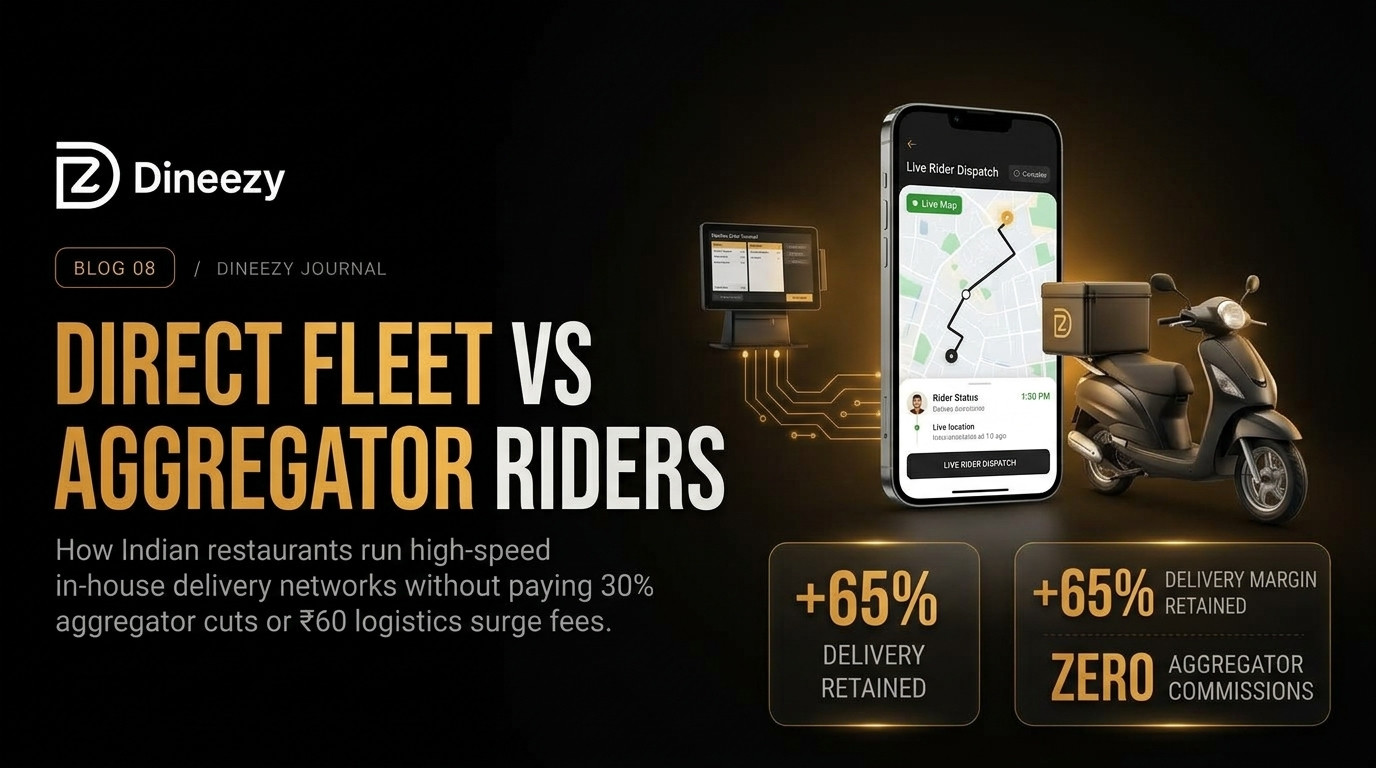
The central nervous system of your delivery operations is the dispatch dashboard on your POS screen. When an online order arrives through your direct digital menu or WhatsApp shop, the system calculates:
- The delivery coordinates and road distance to the customer's doorstep.
- The real-time GPS coordinates of all active in-house riders.
- The kitchen prep time and expected bag-packing timestamp.
Rather than relying on a floor manager shouting across the counter, the system automatically assigns the order to the best-positioned rider or allows one-click assignment based on live queue status.
2. The Native Rider Mobile App
Your delivery partners need a lightweight, frictionless mobile application designed specifically for speed. Dineezy provides a dedicated Rider App (available via direct Android APK) that gives in-house riders:
- Instant Order Alert: Audio and haptic alerts the moment a kitchen ticket is packed and ready.
- Turn-by-Turn Navigation: 1-tap Google Maps or MapmyIndia routing directly to the customer's apartment gate or landmark.
- One-Click Customer Call: Instant masked dialing to the diner without exposing personal numbers.
- Digital Proof of Delivery & Cash Collection: Built-in UPI QR generation for cash-on-delivery (COD) collection and digital delivery signature.
3. Automated WhatsApp Real-Time Tracking for Guests
The biggest reason customers prefer aggregators is visual tracking: they want to know where their food is. If your direct ordering system does not provide live tracking, diners will flood your front desk with phone calls asking, "Bhaiya, order kahan pahuncha?"
With modern integrated delivery, the moment your in-house rider starts their scooter, an automated WhatsApp message fires to the customer:
"Your order #1048 from Urban Cafe is out for delivery! Ramesh is on his way on an electric scooter. Track your delivery live: https://dineezy.in/business"
The customer taps the link to open an interactive, branded map showing the rider moving in real time. It delivers a world-class guest experience that rivals or beats Swiggy Instamart and Zomato Gold.
4. Intelligent Order Batching and Corridors
The secret to high rider productivity is route clustering. If two customers live in the same residential enclave or IT corridor 2.5 kilometers away, a smart dispatch system prompts the kitchen to bundle those orders.
A single delivery rider leaves with two thermal hot-bags and completes both drops in under 24 minutes. Your effective cost per delivery plummets from ₹35 to ₹18, while your riders earn consistent delivery bonuses.
5. In-House Rider Compensation and EV Fleet Economics
How do you retain loyal in-house delivery drivers in a competitive labor market? The most successful Indian restaurants in 2026 combine:
- Base Salary + Trip Incentive: A predictable monthly base (₹16,000 - ₹18,000) plus an incentive of ₹20 to ₹30 per completed drop. On a 25-drop shift, a rider earns ₹500 to ₹750 extra daily.
- Electric Scooter (EV) Fleet Subscriptions: Many restaurants partner with EV rental providers (such as Yulu, Zypp, or Bounce) to supply electric two-wheelers. The restaurant eliminates petrol expense, saving ₹8,000+ per bike monthly while supporting green, zero-emission delivery.
- Staff Meals and Insurance: Providing free kitchen meals and group accident cover creates high rider loyalty and virtually zero churn.
The Multi-Brand & Cloud Kitchen Advantage
If you operate a cloud kitchen running three or four virtual brands (for example, a Biryani brand, a Burger brand, and a Dessert concept) out of a single commercial kitchen, an in-house delivery fleet is your highest-leverage asset.
Instead of paying three separate delivery commissions to third-party aggregators for orders originating from the same facility, your in-house dispatch team routes orders across all your brand menus into a consolidated rider pool.
One rider can pick up a burger box and a biryani pot from the same kitchen prep counter, serving multiple brand customers across the neighborhood with maximum fleet utilization.
---Step-by-Step Implementation Roadmap
Week 1: Demarcate Delivery Radius & Install the Fleet Engine
Define your core profitable delivery zone. Most Indian urban restaurants achieve optimum speed within a 3.5 km to 5.0 km radius. Outside this radius, traffic congestion slows turnaround times.
Configure your delivery zones, delivery fees (e.g. Free Delivery above ₹399; ₹30 flat below ₹399), and enable the Dineezy Multi-Rider Dispatch system on your POS terminal.
Week 2: Onboard and Equip In-House Delivery Partners
Start with two full-time riders for regular weekdays, scaling to three or four during Friday-Sunday peak hours. Install the Dineezy Rider App on their smartphones. Equip each rider with:
- High-density insulated thermal delivery backpack with beverage cup holders.
- Waterproof mobile handlebar mount with vibration dampening.
- Branded uniform or jacket featuring your restaurant's direct ordering QR code.
Week 3: Convert Aggregator Diners into Direct Customers
Every aggregator order that leaves your kitchen is an opportunity to acquire a direct customer. Insert a high-converting "Switch & Save" physical flyer inside every aggregator paper bag:
"Enjoyed your meal? Order directly on WhatsApp next time: Get 20% OFF your first order + 15-Minute Priority In-House Delivery. Scan here: https://dineezy.in/business"
Within sixty days, between 25% and 40% of regular aggregator customers shift to ordering directly through your zero-commission platform.
---Action Checklist: Direct In-House Delivery Readiness
- [ ] Delivery Zone Mapping: Demarcate primary 3.5 km and secondary 5 km geofenced delivery circles.
- [ ] Dineezy Fleet Dispatch Activation: Enable the Multi-Rider module in your Dineezy admin console.
- [ ] Rider App Installation: Download and test the Dineezy Rider APK on team devices.
- [ ] WhatsApp Tracking Webhook: Verify that automated live tracking links fire instantly when orders enter 'Out for Delivery' status.
- [ ] Thermal Packaging Standard: Implement spill-proof tamper-evident seals and rigid drink carriers to prevent transit leakage.
- [ ] Direct Ordering Bag Inserts: Print customized QR flyers offering direct ordering discounts for every outbound parcel.
Frequently Asked Questions
What happens during extreme rain or sudden dinner spikes when our in-house riders are fully occupied?
A smart delivery operation uses a hybrid failover strategy. Your in-house riders handle 80% to 90% of your predictable daily delivery volume at the lowest possible cost. During extreme weather or unprecedented volume spikes, your POS allows you to instantly toggle on secondary hyperlocal 3rd-party logistics for overflow orders without turning down business.
How do we handle Cash-on-Delivery (COD) reconciliation with in-house riders?
The Dineezy Rider App tracks all cash collected per shift in a real-time digital balance ledger. When riders deliver a COD order, they can either show their dynamic UPI QR code for the customer to scan and pay directly into the restaurant's bank account, or collect physical cash. At the end of the shift, the cashier reconciles the collected cash against the rider's digital settlement screen in under sixty seconds.
Is it economically viable for a small cafe with only 25 deliveries a day to hire an in-house rider?
Yes. At 25 deliveries a day, an aggregator takes ₹1,05,000 in commissions monthly (at ₹140 per ₹500 order). Hiring one dedicated in-house rider at ₹22,000 all-inclusive leaves the cafe with an immediate monthly cash savings of over ₹80,000, while ensuring customers receive their food in half the time.
Can in-house riders also help with dine-in operations during slow afternoon delivery hours?
Absolutely. Unlike aggregator couriers who sit idly outside waiting for third-party orders, your in-house fleet is part of your team. During slow delivery hours (3:00 PM to 6:30 PM), in-house team members assist with kitchen prep, inventory stocking, packaging folding, and dining room setup—maximizing your overall labor efficiency.
---The Bottom Line
Food delivery in India is undergoing a structural realignment. Relying exclusively on third-party aggregators means surrendering your profit margins, your customer relationships, and your brand reputation.
Deploying your own direct delivery fleet with automated dispatch, native rider tracking, and instant WhatsApp updates gives your restaurant total control of its economics.
You deliver hotter food, faster, with zero commission—and build a recurring, loyal customer base that stays yours forever.
---Ready to automate your restaurant's direct delivery and launch your in-house rider fleet?
Book a Live Dineezy Demo & Upgrade Your Restaurant System Today
Published by the Dineezy Editorial Team | Dineezy F&B Intelligence
Dineezy Team
Author at Dineezy