Commissary & Central Kitchen Operations: How Indian Food Brands Scale from 3 to 20 Outlets with Zero Quality Loss
Scaling a restaurant brand beyond 3 outlets fails when taste varies. Learn how Indian food chains run central commissary kitchens, master inter-store indents, and cut batch food waste by 65%.
Dineezy Team
14 Oct 2026 · 7 min read
On this page18 sections
- The Multi-Outlet Scaling Trap: Why Outlet #4 Breaks the Brand
- What is a Central Commissary Kitchen?
- 4 Strategic Benefits of the Commissary Operating Model
- 1. 100% Guaranteed Taste Consistency
- 2. Massive Real Estate & Kitchen Space Savings
- 3. Bulk Ingredient Procurement Savings
- 4. Drastic Reduction in Outlet Food Wastage
- How Dineezy Powers Multi-Outlet Central Kitchen Workflows
- Step 1: Automated Outlet Indent Generation
- Step 2: Central Kitchen Production Batch Planning
- Step 3: Dispatch Notes & Inter-Branch Transfer Gate Passes
- Step 4: 1-Click Receiving & Stock Discrepancy Audits
- Practical Financial Comparison: Scaling to 6 Outlets
- Frequently Asked Questions
- When is the right time to transition to a central kitchen?
- What FSSAI licenses are needed for a commissary kitchen?
- How does Dineezy handle recipe ingredient deductions across branches?
- Build Your Restaurant Chain Empire with Dineezy
The Multi-Outlet Scaling Trap: Why Outlet #4 Breaks the Brand
Almost every ambitious Indian restaurateur dreams of turning their popular single cafe, biryani joint, or pizza brand into a multi-city empire. Outlets 1 and 2 perform brilliantly—the founders are physically present every day, tasting gravies, supervising cooks, and maintaining impeccable standards.
Then comes Outlet 3, 4, and 5. Suddenly, customer complaints start pouring in on Google Reviews and Zomato:
- "The Butter Chicken at your Koramangala branch is incredible, but the Whitefield outlet was watery and tasteless!"
- "Your Bandra cafe serves generous portions, but the Andheri outlet cut the portion size in half!"
- "Food took 45 minutes because the outlet ran out of marinated chicken during the dinner rush!"
This is the dreaded Multi-Outlet Scaling Trap. In the Indian food & beverage industry, the single biggest barrier to scaling beyond three locations is inconsistent taste, uncontrolled food wastage, and chaotic inter-outlet logistics.
When every branch prepares sauces, gravies, marinades, and dough from scratch on-site, you are not running one unified brand—you are running five independent, competing kitchens with varying cook temperaments and inconsistent ingredient suppliers.
The solution used by India's most successful chain operators (from Haldiram's and Chaayos to fast-scaling QSRs) is Centralized Commissary & Production Kitchens. Here is the operational and technological playbook for scaling from 3 to 20 outlets without ever compromising quality.
What is a Central Commissary Kitchen?
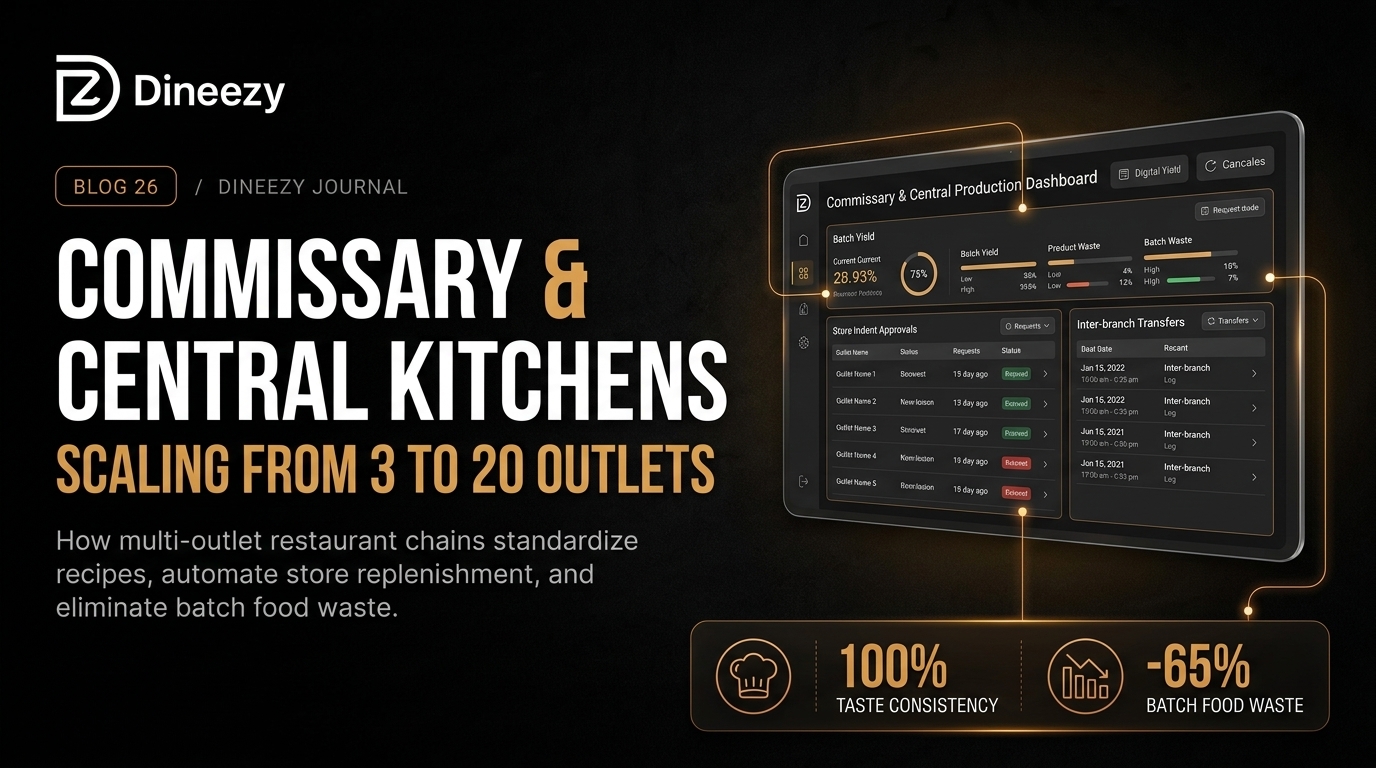
A Commissary Kitchen (or Central Production Unit - CPU) is a dedicated food processing facility where master recipes, gravies, spice blends, marinated meats, bakery items, and signature sauces are prepared in large, standardized batches.
Instead of each retail outlet buying raw onions, ginger, and spices to cook base gravies for four hours every morning:
- The Central Kitchen handles bulk peeling, chopping, braising, and batch cooking.
- Semi-finished products are vacuum-sealed, blast-chilled, and portion-packed with strict expiry batch barcodes.
- Refrigerated delivery vans dispatch stock daily to retail outlets according to digital purchase indents.
- Retail outlets function as high-speed assembly and finishing kitchens: cooks simply heat, assemble, garnish, and serve in under 6 minutes.
4 Strategic Benefits of the Commissary Operating Model
Transforming your restaurant operations with a central kitchen delivers massive operational and financial advantages:
1. 100% Guaranteed Taste Consistency
Whether a guest visits your outlet in South Delhi or Gurgaon, the flavor profile of your Dal Makhani, red sauce pasta, or chai blend is mathematically identical because the base was cooked in the exact same steam kettle under strict temperature-controlled standards.
2. Massive Real Estate & Kitchen Space Savings
Prime retail real estate in Indian commercial hubs (e.g., Connaught Place, Indiranagar, Bandra) costs ₹300 to ₹600 per square foot. In a traditional setup, 50% of that expensive floor space is consumed by oversized prep kitchens, walk-in freezers, and storage racks.
With a commissary setup, satellite retail outlets only require a compact finishing kitchen, freeing up 70% of floor space for revenue-generating guest dining tables.
3. Bulk Ingredient Procurement Savings
Buying raw chicken, cooking oil, dairy, and spices in 5-kilogram packs for individual branches pays retail prices. Procuring raw ingredients at the central commissary level in 500-kilogram bulk batches from wholesale mandis and direct farm producers cuts raw food purchasing costs by 18% to 24% immediately.
4. Drastic Reduction in Outlet Food Wastage
When cooks prepare small batches at individual outlets, end-of-day food spoilage frequently reaches 10% to 15%. In a centralized production unit equipped with blast chillers and vacuum packaging, ingredient batch yields are tightly audited, slashing food waste to under 2.5%.
How Dineezy Powers Multi-Outlet Central Kitchen Workflows
A central commissary without integrated supply chain software quickly devolves into spreadsheet chaos. Dineezy provides a unified multi-outlet ERP and POS platform connecting the central kitchen with every satellite branch:
Step 1: Automated Outlet Indent Generation
At 10:00 PM every night, branch managers do not have to guess what to order. Dineezy analyzes historical sales trends, weekend forecasts, and current closing stock to generate an Automated Indent Proposal:
```
[OUTLET: INDIRANAGAR] - DAILY REPLENISHMENT INDENT
- 15 kg Makhani Gravy Base (Batch #MG-204)
- 25 kg Marinated Tikka Paneer
- 8 kg Pre-portioned Pizza Dough Balls
- 40 units Branded Beverage Glass Bottles
```
The store manager reviews the proposal on their Dineezy POS tablet, makes adjustments, and submits with one tap.
Step 2: Central Kitchen Production Batch Planning
At 6:00 AM, the central kitchen master dashboard aggregates indents across all 8 outlets. The production manager sees the consolidated requirement:
- Total Makhani Gravy Needed: 120 kg
- Ingredients Automatically Deducted from Central Raw Inventory
- Batch Cooking Schedule & Quality Control (QC) Sign-Off
Step 3: Dispatch Notes & Inter-Branch Transfer Gate Passes
When food packets are loaded into dispatch vans, Dineezy generates digital Transfer Delivery Challans and vehicle gate passes with barcode tracking.
Step 4: 1-Click Receiving & Stock Discrepancy Audits
When the van arrives at the retail outlet, the store supervisor scans the barcodes on the Dineezy app to confirm delivery. If 15 kg was dispatched but only 13 kg arrived, Dineezy instantly flags the discrepancy and alerts management, eliminating transit pilferage.
Practical Financial Comparison: Scaling to 6 Outlets
Let us compare the monthly costs of running 6 independent retail kitchens vs. 1 Central Commissary + 6 Satellite Finishing Kitchens:
| Cost Item | 6 Independent Outlet Kitchens | 1 Commissary + 6 Finishing Outlets | Monthly Savings |
|---|---|---|---|
| Kitchen Staff (Head Cooks + Prep) | 30 Cooks (5 per outlet) = ₹7,50,000 | 12 Central + 12 Outlet = ₹6,00,000 | +₹1,50,000 / month |
| Raw Material Procurement (Bulk vs Retail) | ₹18,00,000 / month | ₹14,75,000 / month (18% discount) | +₹3,25,000 / month |
| Food Spoilage & Waste (12% vs 2.5%) | ₹2,16,000 / month loss | ₹36,000 / month loss | +₹1,80,000 / month |
| Retail Real Estate Kitchen Rent | ₹4,80,000 / month across 6 stores | ₹2,40,000 (Stores) + ₹80,000 (Central) | +₹1,60,000 / month |
| Total Monthly Operating Cost | ₹32,46,000 | ₹24,31,000 | ₹8,15,000 SAVED / MONTH |
Centralizing your production saves over ₹8.15 Lakhs every single month (nearly ₹1 Crore per year) while ensuring flawless taste across every dining location.
Frequently Asked Questions
When is the right time to transition to a central kitchen?
The inflection point is typically when a brand reaches 3 to 4 busy locations, or when opening a high-volume cloud kitchen cluster where kitchen rents at retail locations exceed ₹1.5 Lakhs/month.
What FSSAI licenses are needed for a commissary kitchen?
Central food production units in India require a State or Central FSSAI Manufacturing License (depending on production capacity above 2 metric tonnes/day), along with strict compliance with temperature logs, potable water certifications, and pest management records.
How does Dineezy handle recipe ingredient deductions across branches?
Dineezy uses Multi-Tier Bill of Materials (BOM). When the central kitchen cooks a 100kg batch of sauce, it deducts raw tomatoes and spices from raw inventory. When a satellite branch sells a curry, it deducts the semi-finished sauce portion from the branch inventory in real time.
Build Your Restaurant Chain Empire with Dineezy
Expanding your food brand should multiply your profits, not your headaches. Don't let inconsistent cooks or logistics friction kill your company's growth.
With Dineezy's Multi-Outlet Central Kitchen & Inventory Management System, you get the software tools to standardize recipes, automate store replenish indents, and scale to 20+ profitable outlets with complete operational control.
Book a Multi-Outlet Architectural Demo at dineezy.in/business and discover how modern F&B technology turns your restaurant brand into a regional powerhouse.
Dineezy Team
Author at Dineezy