Car Dining & Curbside Ordering: How Drive-Up Restaurants in India Double Revenue Without Adding a Single Table
Introduction: The 10:45 PM Parking Lot Gridlock It is 10:45 PM on a Friday evening outside a popular cafe or late-night eatery in Indiranagar, Cyber Hub, or…
Dineezy Team
10 Sept 2026 · 11 min read
On this page28 sections
- Introduction: The 10:45 PM Parking Lot Gridlock
- The Psychology of the Indian Car Diner in 2026
- 1. The Privacy and Comfort of a Personal Capsule
- 2. Zero Waitlist Friction
- 3. The Death of Aggregator Delivery Markups
- The 4 Operational Disasters of Manual Notepad Car Service
- 1. The Severe Speed Penalty
- 2. High Labor Strain & Waiter Burnout
- 3. Revenue Leakage from Skipped Bills
- How the Modern Car Dining Workflow Operates: Step by Step
- Step 1: Fixed Parking Bay QR Markers
- Step 2: Dynamic Digital Menu with Car Plate Tagging
- Step 3: Instant Kitchen KOT Auto-Routing
- Step 4: Upfront In-Car UPI Settlement
- Step 5: Window-Mounted Car Tray Delivery
- The Unit Economics: What 30 Extra Car Covers Deliver Monthly
- Financial Breakdown (Monthly Impact):
- Practical Design Elements: Setting Up a High-Converting Car Dining Station
- 1. Specialized In-Car Packaging & Clip-On Trays
- 2. Bold, Reflective Bay Numbering
- 3. Dedicated Outdoor Dispatch Runners
- Action Checklist: Launching Car Dining at Your Restaurant
- Frequently Asked Questions
- Can any restaurant launch car dining, or do you need a private parking lot?
- What happens if a customer parks in Bay 2 but mistakenly scans the QR code for Bay 3?
- How does in-car QR ordering handle repeat beverage or dessert reorders?
- Do we need to pay commissions on car dining orders?
- The Bottom Line
Introduction: The 10:45 PM Parking Lot Gridlock
It is 10:45 PM on a Friday evening outside a popular cafe or late-night eatery in Indiranagar, Cyber Hub, or Jubilee Hills. Inside, all forty dining tables are completely full. A waiting queue of fifteen walk-in diners spills out of the entrance doorway.
Outside, however, the real action is unfolding in the parking lot.
Twenty-two cars are parked in rows with engines idling or hazard lights blinking. Groups of young professionals, couples, and families are sitting inside their vehicles with windows rolled halfway down, desperate to eat without waiting forty minutes for an indoor table.
To serve this booming demand, the restaurant has assigned three young waiters with paper notepads and ballpoint pens to run across the asphalt.
- The 15-Minute Menu Wait: A waiter sprints from car to car carrying laminated paper menus. Car 4 waves frantically for ten minutes just to flag down a server.
- The Kitchen Relay Bottleneck: The waiter scribbles handwritten orders on a crumpled pad, walks back inside the crowded restaurant, and waits in line at the central billing terminal to manually punch the items into the POS.
- The License Plate Mix-Up: At 11:15 PM, a food runner emerges holding a stainless-steel tray with a steaming Truffle Burger and two Cold Brews. He shouts, "White Swift? White Creta?" In the dark parking lot, three white SUVs look identical. The food goes to the wrong car, gets sent back cold, and the kitchen loses ₹680 in wasted inventory.
- The Unpaid Drive-Off: Another customer finishes eating, waits twelve minutes for the card swipe EDC machine to arrive, gets impatient, and drives off into traffic without settling the ₹520 bill.
This is the chaotic reality of manual car dining across India. Car dining is one of the highest-margin, fastest-growing revenue segments in Indian F&B—yet most restaurants manage it with nineteenth-century tools.
In 2026, forward-thinking cafes, highway food hubs, and quick-service brands are unlocking an extra 30 to 50 covers every single night—without paying one rupee of additional commercial rent or giving 30% cuts to food delivery aggregators.
Here is how the Car Dining & Curbside revolution works, why manual paper ordering breaks down, and how intelligent drive-up technology turns your parking lot into your most profitable dining room.
---The Psychology of the Indian Car Diner in 2026
Why has in-car dining exploded across Indian metros and Tier-1 cities over the past two years?
Consumer behavior has shifted dramatically due to three distinct dining preferences:
1. The Privacy and Comfort of a Personal Capsule
After eight hours in a corporate office or battling metropolitan traffic, many diners do not want the sensory overload of a noisy, crowded indoor restaurant room. A private car offers personalized air conditioning, custom music, privacy for conversation, and total personal space.
2. Zero Waitlist Friction
When a popular restaurant has a 45-minute waitlist at the host desk, hungry guests often walk away to a competitor. Car dining converts immediate walkaways into paying customers: "Our indoor tables are full, but pull into Bay 6 and your food will arrive in twelve minutes."
3. The Death of Aggregator Delivery Markups
Customers are increasingly fatigued by inflated aggregator menu prices, ₹17.58 platform fees, rainy-day surcharges, and soggy French fries that spent thirty-five minutes in a delivery backpack. Diners are willing to drive five kilometers to park outside their favorite burger joint or chai cafe to enjoy piping-hot food at original in-store menu prices.
---The 4 Operational Disasters of Manual Notepad Car Service
Most restaurant operators recognize the revenue potential of drive-up orders, but attempt to handle them with their existing floor staff. This approach reliably creates four severe operational bottlenecks:
| Operational Dimension | Manual Paper Notepad Car Service | Automated Digital Car Dining System |
|---|---|---|
| Order Placement Time | 12 to 18 minutes (waiting for runner to bring menu) | Under 45 seconds (instant QR scan from car window) |
| Kitchen Dispatch (KOT) | Manual walk back to indoor POS terminal | Instant digital routing directly to kitchen display (KDS) |
| Vehicle Identification | Vague handwritten descriptions ("Grey Baleno near tree") | Exact Bay Number + Verified Vehicle Plate Tag |
| Bill Settlement | Wait for card swipe EDC machine or physical cash change | Instant in-car UPI payment upon order placement |
| Average Bay Turnover | 55 to 70 minutes per car | 28 to 35 minutes per car |
| Aggregator Commission | 0% (but high order shrinkage & unpaid exits) | 0% (100% margin retained + zero unpaid exits) |
1. The Severe Speed Penalty
In dine-in restaurant operations, every minute a parking bay or dining table sits occupied without food is lost revenue. In manual car dining, between menu delivery, order taking, POS re-entry, and bill collection, up to twenty-five minutes of total vehicle dwell time is pure administrative dead-air.
2. High Labor Strain & Waiter Burnout
Asking indoor servers to dodge reversing vehicles in dark parking lots while balancing food trays in humid or rainy weather causes high staff turnover, dropped food trays, and frayed customer tempers.
3. Revenue Leakage from Skipped Bills
When outdoor staff are overwhelmed, unscrupulous drivers occasionally start their engines and drive away before the waiter returns with the final bill. Restaurant owners absorb thousands of rupees in monthly shrinkage that is completely preventable.
---How the Modern Car Dining Workflow Operates: Step by Step
Transforming an unorganized parking area into a streamlined, high-speed drive-up revenue engine requires replacing paper notepads with a closed-loop digital architecture:
Step 1: Fixed Parking Bay QR Markers
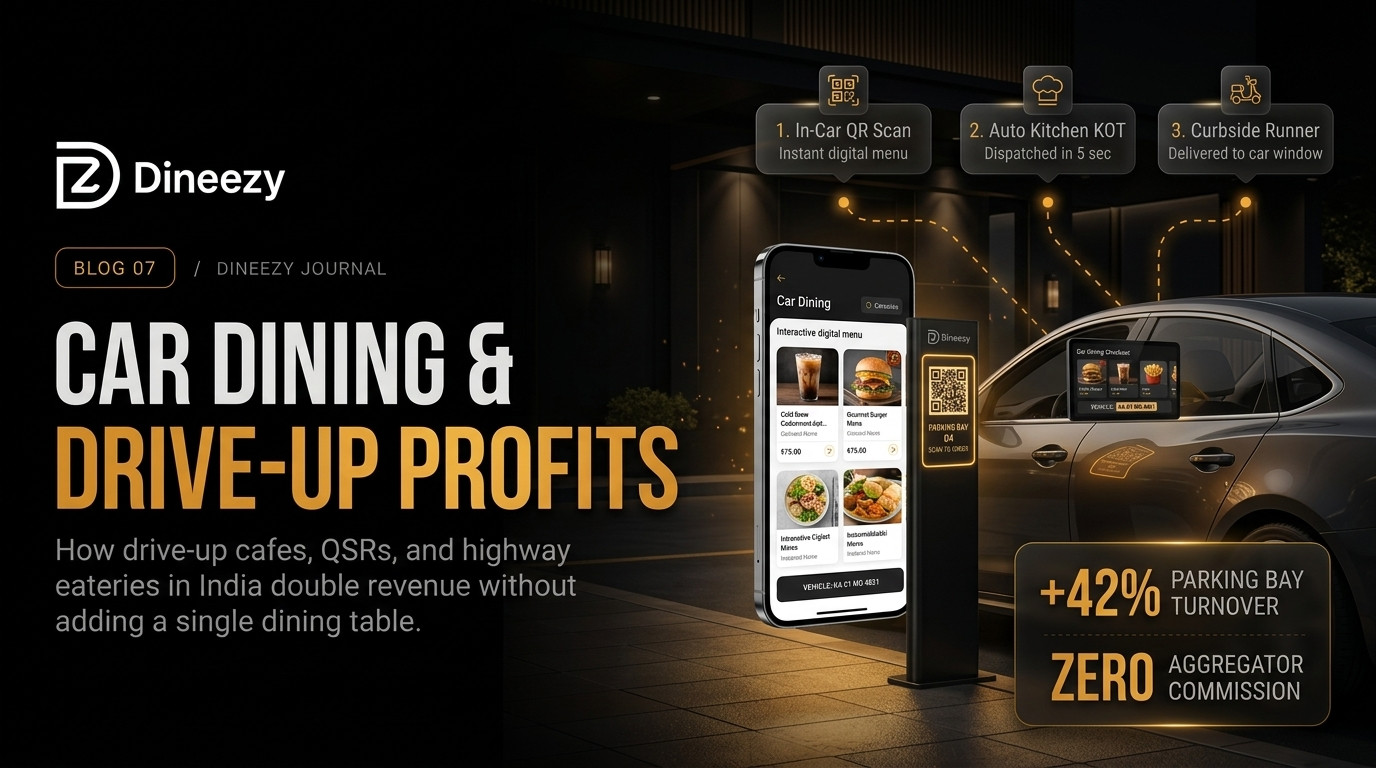
Each parking slot outside the restaurant or cafe is assigned a permanent, weather-resistant, reflective QR marker or illuminated bollard stanchion (e.g., BAY 01, BAY 02, BAY 03).
When a vehicle pulls into the parking space, the driver rolls down their window and scans the QR code using their smartphone camera. There is no mobile application to download, no login barrier, and no OTP delay.
Step 2: Dynamic Digital Menu with Car Plate Tagging
The Dineezy digital menu loads instantly in the customer's mobile browser. The system automatically locks the order to PARKING BAY 04.
Before adding items to their cart, a clean input prompt asks for the vehicle's last four registration digits (e.g., "Vehicle Number: KA 01 MG 4821"). This creates an unbreakable, two-factor identifier: the runner knows both the exact bay number and the license plate of the car.
Step 3: Instant Kitchen KOT Auto-Routing
The moment the customer taps submit, the order bypasses the front-of-house cashier entirely. An electronic Kitchen Order Ticket (KOT) fires immediately on the kitchen display system (KDS) or thermal prep printer, marked with a distinctive outdoor tag: [CAR DINING - BAY 04 - MH 02 DT 9912].
The kitchen starts preparing the food within five seconds of order placement.
Step 4: Upfront In-Car UPI Settlement
Payment occurs at the time of ordering. The customer completes payment via GPay, PhonePe, Paytm, or credit card directly in the browser interface. The restaurant collects one hundred percent of the funds upfront, eliminating unpaid drive-offs and eliminating the need for runners to carry bulky wireless card swipe terminals outside.
Step 5: Window-Mounted Car Tray Delivery
When the kitchen marks the order ready, an outdoor runner places the packaged items on a clip-on car window food tray, walks directly to Bay 04, verifies the license plate, and clips the tray to the driver's door window in under fifteen seconds. The guest enjoys hot, fresh food in the comfort of their air-conditioned vehicle.
---The Unit Economics: What 30 Extra Car Covers Deliver Monthly
Let us look at the real financial impact for an Indian restaurant or cafe operating with 10 dedicated car parking spaces in a busy commercial or nightlife district:
"A restaurant with 40 indoor seats might turn those tables twice during a dinner rush, serving 80 guests. But if that same venue has 10 parking bays in front and turns each bay three times between 8:00 PM and midnight, it serves an additional 30 vehicles—generating 60 to 90 extra covers without adding one square foot of carpet area."
Financial Breakdown (Monthly Impact):
- Dedicated Car Parking Slots: 10 bays
- Average Vehicles Served Per Evening: 25 cars
- Average Order Value (AOV): ₹550 (two burgers, fries, specialty drink)
- Daily Incremental Revenue: 25 cars × ₹550 = ₹13,750 / day
- Monthly Incremental Revenue (30 Days): ₹4,12,500 / month
- Raw Food Cost (COGS at 32%): -₹1,32,000
- Packaging & Disposable Trays (5%): -₹20,625
- Dedicated Outdoor Runners (2 staff at ₹18,000): -₹36,000
- Aggregator Commissions Paid: ₹0 (0% Commission)
- Net Monthly Contribution Profit: ₹2,23,875 / month
Over a twelve-month operational cycle, that represents over ₹26.8 Lakhs in pure incremental bottom-line profit generated purely from space that was previously sitting as passive asphalt.
---Practical Design Elements: Setting Up a High-Converting Car Dining Station
If you are planning to launch car dining at your restaurant, cafe, or QSR, implement these three operational best practices:
1. Specialized In-Car Packaging & Clip-On Trays
Eating inside a motor vehicle requires spill-proof design. Invest in sturdy car window food trays (which hook securely onto standard door frames) and use deep burger clamshells, drink carriers with secure lids, and pre-packaged wet wipes. The easier you make it to eat without spilling sauce on car upholstery, the faster your repeat customer rate grows.
2. Bold, Reflective Bay Numbering
Do not use small paper stickers on parking walls. Install high-contrast, reflective metal signage or illuminated bollard stanchions at hood height. In rainy weather or at 11:30 PM, drivers must be able to spot their bay number instantly under headlights.
3. Dedicated Outdoor Dispatch Runners
Never mix indoor dining servers with outdoor parking runners. Designate one or two runners whose sole responsibility is monitoring the outdoor dispatch screen, picking up packaged car trays, and delivering them to bays. This prevents indoor service standards from slipping during busy dinner peaks.
---Action Checklist: Launching Car Dining at Your Restaurant
Review this operational checklist before opening your parking bays for digital orders:
- [ ] Parking Bay Audit: Demarcate and number 4 to 12 parking bays clearly with reflective signage visible at night.
- [ ] Dineezy Bay-Specific QR Codes: Generate unique QR codes linked to each individual bay number in your Dineezy dashboard.
- [ ] Vehicle Tagging Field: Enable mandatory vehicle license plate collection on the digital checkout screen.
- [ ] Instant UPI Integration: Configure upfront digital payment so every car order is settled before cooking begins.
- [ ] In-Car Packaging Inventory: Stock clip-on door trays, leak-proof drink cups, and heavy-duty greaseproof boxes.
- [ ] Runner Dispatch Station: Set up a dedicated staging shelf near the kitchen exit specifically for outdoor car orders.
Frequently Asked Questions
Can any restaurant launch car dining, or do you need a private parking lot?
While having a dedicated private parking lot is ideal, many successful urban cafes and highway restaurants operate car dining along frontage parking bays, curbside pickup lanes, or partnered commercial parking zones. As long as vehicles can park legally without blocking traffic, bay QR codes can be deployed.
What happens if a customer parks in Bay 2 but mistakenly scans the QR code for Bay 3?
This is precisely why Dineezy pairs the bay number with the vehicle registration tag. When the runner walks outside holding an order for Bay 3, the runner instantly cross-checks the physical license plate. If the car is parked in Bay 2, the runner identifies the vehicle immediately without confusion.
How does in-car QR ordering handle repeat beverage or dessert reorders?
Customers keep the digital menu open on their mobile browser throughout their meal. If they want a second cold brew or a chocolate brownie after finishing their meal, they simply tap the item and pay via 1-click UPI. The kitchen receives the add-on KOT immediately, and a runner delivers it straight to their window.
Do we need to pay commissions on car dining orders?
No. When customers scan your Dineezy parking bay QR code, the transaction flows directly between your customer and your bank account. There are zero aggregator commissions, saving you 25% to 35% compared to delivery apps.
---The Bottom Line
In 2026, the most successful Indian restaurateurs do not think of their business within the four walls of their dining room.
Your parking lot is not just a place for customers to leave their vehicles while they wait for an indoor table. It is an untapped, high-margin dining room waiting to be activated.
By giving diners the convenience of in-car QR ordering, instant UPI settlement, and flawless window delivery, you double your turnover, eliminate aggregator commissions, and turn late-night parking traffic into pure profit.
---Ready to turn your parking bays into high-revenue car dining stations?
Book a Live Dineezy Demo & Upgrade Your Restaurant POS Today
Published by the Dineezy Editorial Team | Dineezy F&B Intelligence
Dineezy Team
Author at Dineezy