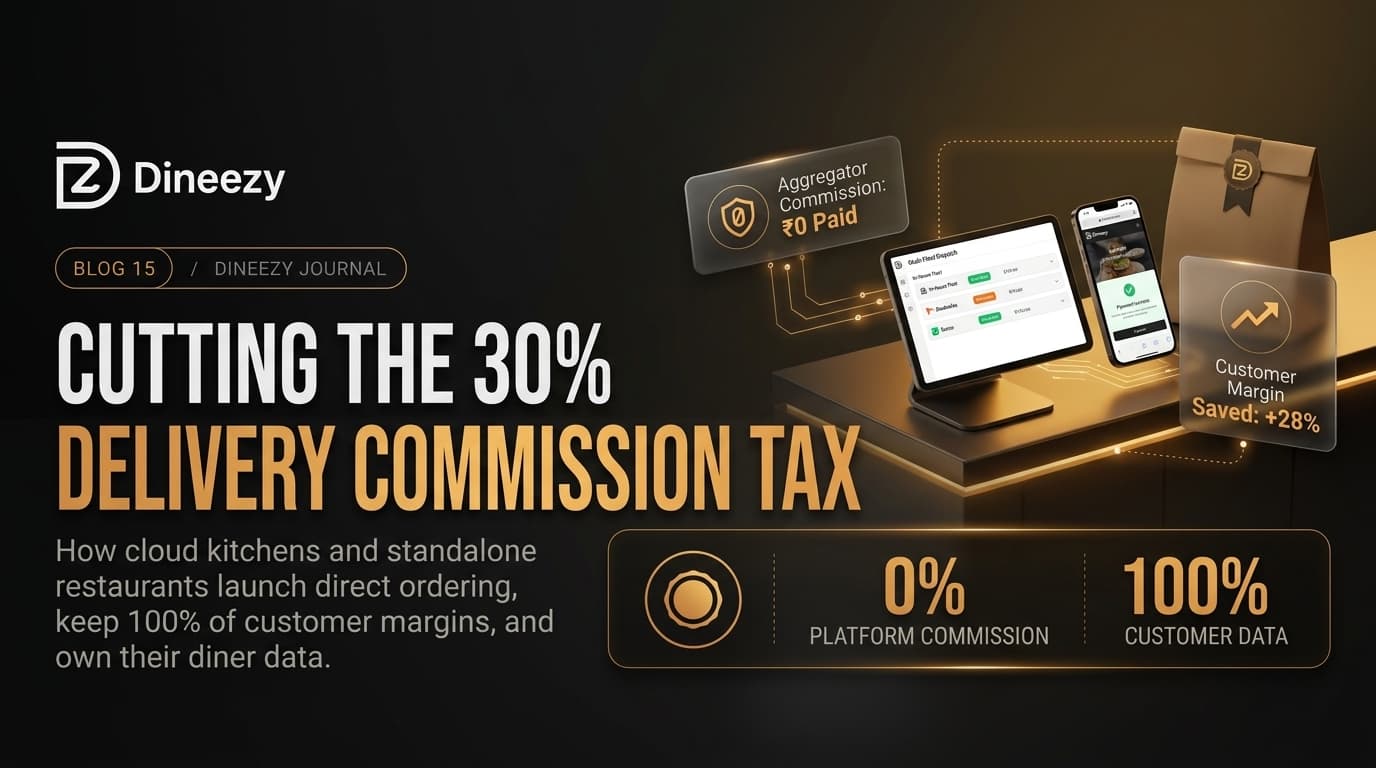
The True Cost of Swiggy & Zomato in 2026: How Indian Restaurants Can Reclaim 25–40% Margins
Introduction: The Aggregator Paradox in Indian Food Service For the past decade, food delivery aggregators like Swiggy and Zomato have been celebrated as the…
Dineezy Team
6 Sept 2026 · 12 min read

On this page27 sections
- Introduction: The Aggregator Paradox in Indian Food Service
- The Myth of the 20% Commission: Unmasking the Hidden Math
- 1. The 18% GST on Commissions (Not Food GST)
- 2. Mandatory Co-Funded Discounts and Platform Promos
- 3. Cost-Per-Click (CPC) Sponsored Ad Spend
- 4. Payment Gateway and Delivery Surcharges
- The P&L Breakdown: A Tale of Two ₹500 Orders
- The Hidden Threat: Customer Data Masking & Brand Erosion
- 1. The Masked Phone Number Wall
- 2. The Platform Retargeting Trap
- 3. The Private-Label Threat
- The 2026 Strategy: Use Aggregators as Discovery, Shift Repeats to Direct
- Step-by-Step Blueprint to Reclaiming 25–40% Restaurant Margins
- Step 1: Set Up Your Zero-Commission Direct Storefront
- Step 2: The Packaging Insert "Bridge Strategy"
- Step 3: Instant WhatsApp Billing & 100% Data Capture
- Step 4: Automated WhatsApp Retargeting & Re-Ordering Hooks
- Step 5: Hybrid Logistics (In-House Staff + On-Demand Hyperlocal Fleets)
- The Annual Financial Impact: Doing the Math for Your Restaurant
- Frequently Asked Questions (FAQs)
- Q1. Will customers really stop ordering on Swiggy and Zomato to order directly from my restaurant?
- Q2. Do I have to delist my restaurant from Swiggy and Zomato to use Dineezy?
- Q3. How do I handle delivery riders for direct orders?
- Q4. What is the commission rate charged by Dineezy?
- Q5. How fast can my restaurant launch direct ordering with Dineezy?
- Conclusion: Take Back Control of Your Restaurant's Future
- Ready to Stop Bleeding Commissions & Own Your Customer Data?
Introduction: The Aggregator Paradox in Indian Food Service
For the past decade, food delivery aggregators like Swiggy and Zomato have been celebrated as the great democratizers of the Indian restaurant industry. A small biryani outlet in Hyderabad or a boutique cafe in Bengaluru's Indiranagar could suddenly reach hundreds of thousands of hungry diners without investing in prime street-front commercial real estate or building an in-house delivery fleet. By 2026, the online food delivery market in India has surged past $15 billion, with millions of orders processed every single day.
Yet, step into the back office of virtually any Indian restaurant, cafe, QSR chain, or cloud kitchen today, and you will uncover a stark reality: order volumes have skyrocketed, but net profit margins have shrunk to historic lows.
Restaurant owners find themselves trapped in an aggregator paradox. They are busier than ever, kitchens are churning out food at peak capacity, delivery riders are constantly lining up outside—yet bank balances tell a completely different story. Between rising food inflation, skyrocketing commercial gas tariffs, and layered commission structures, many operators are operating at razor-thin margins of 3% to 6%, while third-party platforms capture a staggering portion of their revenue.
In this comprehensive, data-backed 2026 guide, we break down the real, full math behind third-party aggregator commissions in India, reveal the hidden fees eating your profits, and provide a concrete, step-by-step roadmap to shift your high-margin repeat customers to direct, zero-commission ordering channels powered by Dineezy.
The Myth of the 20% Commission: Unmasking the Hidden Math
When aggregator sales representatives pitch new restaurant owners, they typically quote a headline base commission figure—usually somewhere between 18% and 25%. On paper, giving up a fifth of the top line in exchange for marketing, technology, and last-mile delivery riders appears to be an acceptable tradeoff.
However, the headline commission rate is only the tip of the iceberg. Once the monthly payout statement arrives, most operators discover that the effective take rate is significantly higher.
1. The 18% GST on Commissions (Not Food GST)
Many first-time restaurateurs overlook that the Government of India levies an 18% Goods and Services Tax (GST) on technology and logistics platform fees. If an aggregator charges a 24% base commission on a ₹1,000 order (₹240), an additional 18% GST is added to that commission service fee (₹43.20), bringing the platform deduction alone to ₹283.20—or 28.32% of the gross ticket value.
2. Mandatory Co-Funded Discounts and Platform Promos
To qualify for top search visibility or badge placement in aggregator feeds (like "Gold", "One", or "Super Saver Deals"), restaurants are practically coerced into funding 40% to 60% of deep-discount promo codes (e.g., "Flat ₹100 Off" or "50% Off up to ₹120"). When the restaurant absorbs ₹60 to ₹100 of discount per order, that deduction comes straight out of the food maker's gross margin.
3. Cost-Per-Click (CPC) Sponsored Ad Spend
As millions of cloud kitchens and dining spots flood the platforms, organic search visibility has plummeted. To stay on page one for searches like "best butter chicken near me" or "artisan coffee", operators must invest in platform ad bidding. High-growth restaurants routinely spend an additional 5% to 8% of total revenue just bidding on their own brand keywords and carousel banners to maintain order velocity.
4. Payment Gateway and Delivery Surcharges
Layered on top are payment processing fees (1.5%–2%), handling surcharges, and order cancellation penalties where restaurants often absorb food waste costs even when cancellations occur due to rider delays.
Industry Reality Check (2026): In 2026, the true effective take rate across Indian food delivery aggregators ranges between 28% and 42% of gross order value for independent restaurants and regional cloud kitchens.
The P&L Breakdown: A Tale of Two ₹500 Orders
Let us look at the granular unit economics of a standard ₹500 food order in an Indian metro (e.g., Delhi-NCR, Mumbai, or Pune). Here is where the money actually goes:
| Line Item | Aggregator Order (Swiggy / Zomato) | Direct Ordering (via Dineezy Storefront) |
|---|---|---|
| Gross Order Value (Food) | ₹500.00 | ₹500.00 |
| Co-Funded Customer Discount | -₹75.00 (15% promo) | ₹0.00 (or optional 10% loyalty perk) |
| Net Food Bill | ₹425.00 | ₹500.00 |
| Food Cost / Raw Materials (COGS ~30%) | -₹150.00 | -₹150.00 |
| Packaging & Disposables | -₹25.00 | -₹25.00 |
| Base Commission (22%) | -₹110.00 | ₹0.00 (Zero Commission) |
| 18% GST on Commission | -₹19.80 | ₹0.00 |
| Payment Processing / Gateway Fee | -₹8.50 (2%) | -₹0.00 (Direct UPI) / -₹5.00 |
| Delivery Cost (Rider Fleet / Hyperlocal) | Included in platform charge | -₹40.00 (Dunzo / Shadowfax / Own Staff) |
| Kitchen Labor & Overhead (~20%) | -₹100.00 | -₹100.00 |
| Net Profit to Restaurant | +₹11.70 (2.3% Net Margin) | +₹180.00 (36% Net Margin) |
The difference is staggering: On the exact same ₹500 order, the restaurant earns ₹11.70 through the aggregator versus ₹180.00 through direct channels. To make ₹1,800 in net profit, the restaurant would have to cook and pack 150 aggregator orders versus just 10 direct orders!
The Hidden Threat: Customer Data Masking & Brand Erosion
High financial commissions are devastating, but there is an even bigger existential threat facing Indian restaurant operators: You do not own your customers.
1. The Masked Phone Number Wall
When an order arrives on your aggregator kitchen merchant app, the customer's phone number is masked (e.g., +91-8045XXXXXX virtual forwarding). You have no idea whether this diner has ordered from you once or fifty times. You cannot send them a thank-you message, invite them to your physical restaurant, or alert them when you launch an exciting new seasonal menu.
2. The Platform Retargeting Trap
Because the aggregator retains complete ownership of your customer's browsing behavior, preferences, and dietary patterns, they actively use that data against you. When a loyal patron opens the app tomorrow, the algorithm may feature a sponsored competitor, offering a 60% discount right above your listing.
3. The Private-Label Threat
Aggregators have access to granular neighborhood-level consumption trends: which pin codes crave authentic Neapolitan pizza, what price points convert highest, and which menu categories have supply gaps. Armed with your sales history, platforms can launch their own private-label dark kitchens right down the street, capturing the very demand your kitchen created.
The 2026 Strategy: Use Aggregators as Discovery, Shift Repeats to Direct
Does this mean Indian restaurants should boycott Swiggy and Zomato entirely? Absolutely not.
Aggregators possess unmatched search discovery and logistics density. Cutting them off cold turkey would starve a restaurant of top-of-funnel customer acquisition. Instead, smart operators in 2026 adopt a Hybrid Customer Journey Strategy:
The Golden Rule of Restaurant Profitability:
Pay the aggregator commission ONCE to acquire the customer on their first order. Never pay a 30% commission on their second, third, or twentieth order.
By capturing diners on their first delivery and providing an irresistible direct-ordering incentive, restaurants can organically migrate 25% to 45% of their total order volume to commission-free direct channels within 90 days.
Step-by-Step Blueprint to Reclaiming 25–40% Restaurant Margins
Here is the proven tactical playbook that hundreds of Indian F&B businesses are executing right now using the Dineezy restaurant technology suite:
Step 1: Set Up Your Zero-Commission Direct Storefront
Your customers want convenience. If ordering directly from you requires downloading a heavy mobile app, filling out 10-field registration forms, or waiting on hold on a phone call, they will instinctively return to Swiggy or Zomato.
With Dineezy, your restaurant gets a lightning-fast, mobile-first digital web ordering menu and automated WhatsApp ordering bot that requires zero app downloads. Customers can browse your complete menu with high-resolution photos, customize toppings or spice levels, and checkout in under 30 seconds with direct UPI payments (Google Pay, PhonePe, Paytm) that deposit funds instantly into your bank account—with zero commission fees.
Step 2: The Packaging Insert "Bridge Strategy"
Every single aggregator delivery bag that leaves your kitchen is an unexploited media channel. Never send an order out without a beautifully designed physical packaging flyer or coaster.
Print a high-quality insert that directly communicates value to the customer:
- Headline: "Love our food? Order directly from us next time & get 20% OFF every order + free Gulab Jamun!"
- Call to Action: A crisp, scannable QR code that launches your direct Dineezy WhatsApp ordering bot or mobile menu.
- Financial Incentive: Because you save 30% on aggregator fees, giving your direct customer a 15% discount still leaves you with a 15% net margin expansion, while making the customer feel like an insider getting the best price in town!
Step 3: Instant WhatsApp Billing & 100% Data Capture
For your dine-in and takeaway patrons, stop printing thermal paper slips that end up in the dustbin. Thermal paper costs Indian restaurants ₹3,000–₹6,000 every month and captures zero data.
With Dineezy's integrated WhatsApp Billing, your POS automatically sends a GST-compliant digital invoice straight to the diner's WhatsApp number. Instantly, your CRM captures their verified mobile number, visit timestamp, favorite dishes, and lifetime spend history. Now, you have a direct communication channel to invite them to order delivery directly to their home or office whenever hunger strikes.
Step 4: Automated WhatsApp Retargeting & Re-Ordering Hooks
Unlike email (which has an 8% open rate) or SMS (which lands in spam), WhatsApp boasts a 98% open rate in India. With Dineezy's automated customer lifecycle engine, you can trigger high-converting conversational campaigns on complete autopilot:
- Friday Evening Office Nudges: At 5:30 PM on Fridays, trigger a broadcast to your high-frequency corporate diners: "Kickstart your weekend! Order your favorite Biryani Combo directly via WhatsApp and get it delivered piping hot in 30 minutes."
- 30-Day Inactive Win-Back: Automatically detect customers who haven't ordered in 30 days and offer a personalized perk: "We miss you, Rohan! Here is a complimentary chocolate lava cake on your direct order today."
- Match-Day & Festive Specials: Broadcast 1-click ordering buttons during IPL matches, festive holidays, or rainy days when delivery demand peaks.
Step 5: Hybrid Logistics (In-House Staff + On-Demand Hyperlocal Fleets)
Restaurant owners often ask: "If I don't use Swiggy or Zomato riders, how do I deliver direct orders?"
In 2026, the logistics landscape in India has matured dramatically. Modern restaurants use a two-tiered fulfillment model:
- For nearby deliveries (< 2 km): Employ 1 or 2 in-house staff who handle deliveries during peak hours and manage kitchen prep during downtime.
- For wider radius deliveries (2–8 km): Connect your Dineezy POS directly to on-demand hyperlocal delivery APIs like Shadowfax, Dunzo for Business, Porter, or Rapido. With a single click on your POS screen, an external rider is dispatched to your kitchen for a flat fee of ₹35–₹50 per delivery, completely decoupled from your order value!
The Annual Financial Impact: Doing the Math for Your Restaurant
Let us calculate the concrete financial upside for an independent restaurant or QSR outlet in India doing 1,200 delivery orders per month with an Average Order Value (AOV) of ₹600:
- Monthly Delivery Revenue: 1,200 orders × ₹600 = ₹7,20,000 (₹7.2 Lakhs)
- Current Aggregator Commission Drain (at 30% effective take rate): ₹2,16,000 every month
- Annual Commission Paid to Aggregators: ₹25,92,000 (~₹26 Lakhs) every year!
Now, imagine you execute the Dineezy direct-order playbook and migrate just 35% of those orders (420 orders/month) to your direct WhatsApp and web storefront:
💡 The 35% Migration Financial Dividend:
• Gross direct order sales: 420 orders × ₹600 = ₹2,52,000 / month
• Saved aggregator commission (30%): ₹75,600 / month
• Less: 3rd-party delivery dispatch cost (420 × ₹45): -₹18,900 / month
• Less: Customer 10% direct loyalty discount: -₹25,200 / month
• Net Extra Cash Flow in Restaurant Owner's Pocket: ₹31,500 every month
• Total Annual Added Net Profit: ₹3,78,000 (₹3.78 Lakhs) pure profit!
For a multi-outlet chain or high-volume cloud kitchen operating 3 to 5 brands, shifting repeat orders to direct channels frequently unlocks ₹15 Lakhs to ₹40 Lakhs in annualized bottom-line savings—money that can be reinvested into expanding locations, hiring top culinary talent, or upgrading kitchen infrastructure.
Frequently Asked Questions (FAQs)
Q1. Will customers really stop ordering on Swiggy and Zomato to order directly from my restaurant?
Yes—if you provide a frictionless experience and clear value. When customers realize that ordering directly gives them lower menu prices, exclusive combo deals, faster delivery, and free loyalty perks without having to download a clunky new app, repeat diners enthusiastically switch to your direct WhatsApp or web link.
Q2. Do I have to delist my restaurant from Swiggy and Zomato to use Dineezy?
Not at all! In fact, we recommend keeping your listings active on aggregators as discovery channels. Dineezy unifies your operations so you manage walk-in diners, table QR orders, aggregator tickets, and direct WhatsApp orders from a single, centralized kitchen dashboard.
Q3. How do I handle delivery riders for direct orders?
You have total flexibility. You can use your own in-house staff or integrate your Dineezy POS with on-demand hyperlocal delivery fleets like Shadowfax, Dunzo, or Rapido. You pay a predictable, flat delivery fee per drop rather than a percentage of your food bill.
Q4. What is the commission rate charged by Dineezy?
Dineezy charges 0% commission on your orders. You pay a simple, transparent software subscription, allowing 100% of your order revenue and customer data to remain strictly yours.
Q5. How fast can my restaurant launch direct ordering with Dineezy?
You can be live within 24 to 48 hours. Our onboarding team uploads your existing menu, sets up your custom WhatsApp bot and branded online ordering portal, connects your UPI payment gateway, and trains your team on the intuitive POS dashboard.
Conclusion: Take Back Control of Your Restaurant's Future
Aggregators served a valuable purpose in introducing India to online food delivery. But in 2026, relying solely on third-party platforms with 30%+ effective commissions is a recipe for stagnation and financial exhaustion.
The most successful restaurant brands in India are those that own their brand, own their customer relationships, and protect their hard-earned margins. By adopting a direct-to-consumer ordering stack with Dineezy, you turn delivery into what it was always supposed to be: a sustainable, high-margin growth engine for your culinary passion.
Ready to Stop Bleeding Commissions & Own Your Customer Data?
Join hundreds of restaurants, cafes, and cloud kitchens across India using Dineezy's zero-commission POS, WhatsApp billing, and automated direct ordering systems to boost profits by 25–40%.
Book a Free Live Demo on Dineezy →Dineezy Team
Author at Dineezy